
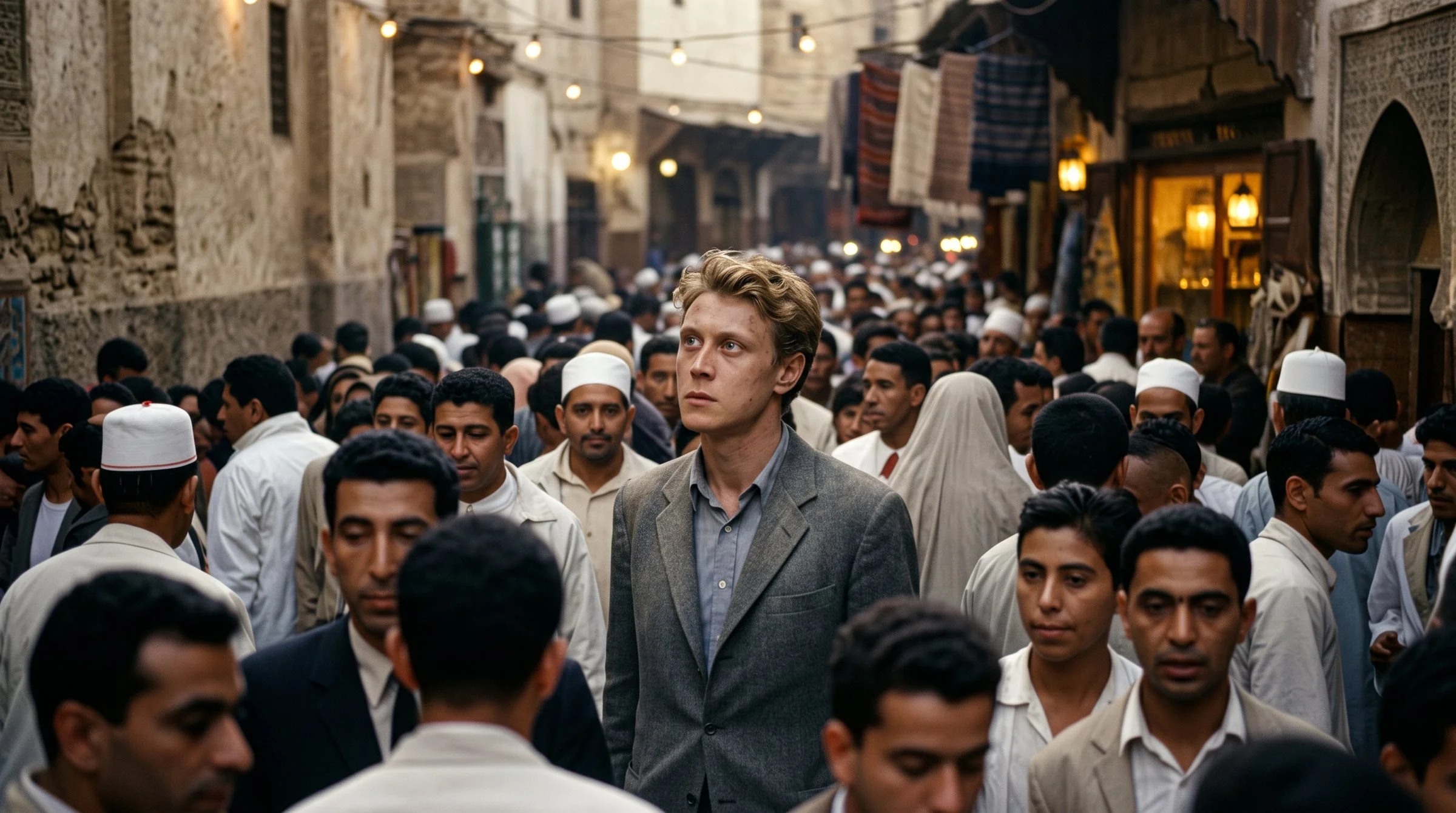
A feature film · English & Arabic
The Book
of Strangers
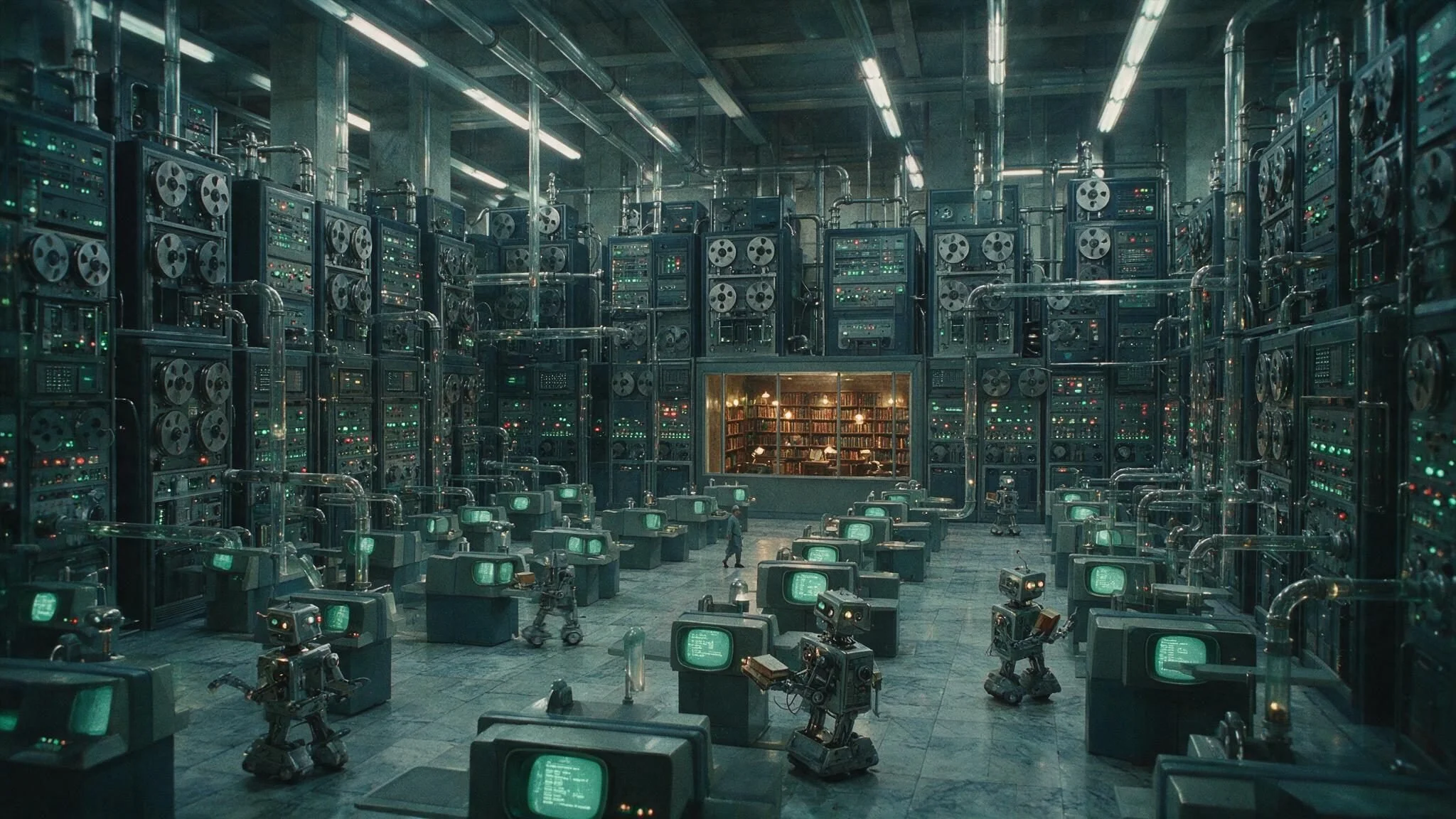
Never have we had so much access to information.
Never have we been so utterly lost.
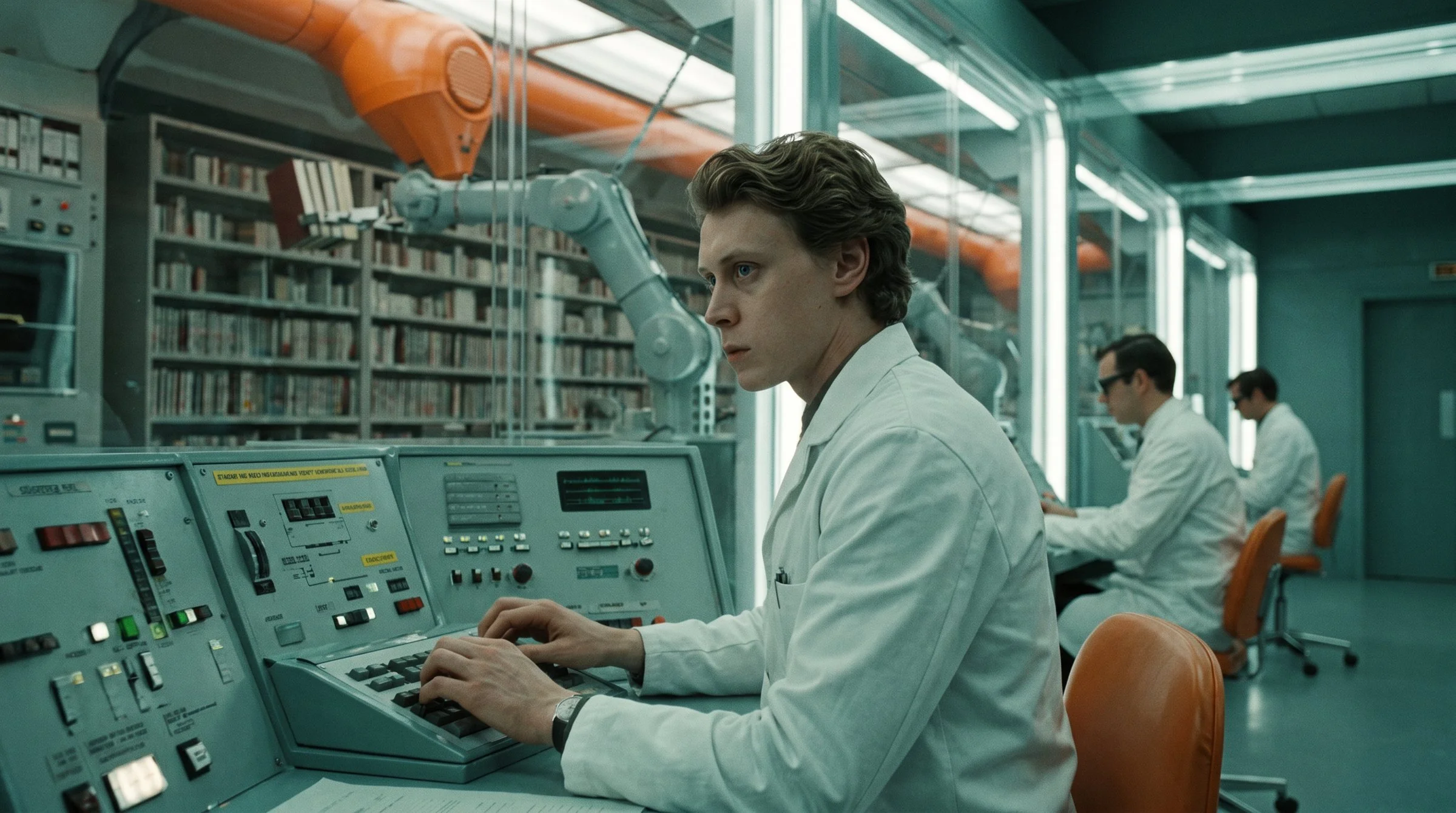
Logline
In a world governed by machines, a records specialist finds a sentence hidden behind a picture, in the hand of the man who vanished before him.
He walks out of the largest library ever built and crosses the sea to find that man. He lives beside him for four months, and does not recognise him.
For readers of the novel
What the film changes
One man
The novel has two: the nameless clerk, and Kasul, whose notebook the clerk reads. The film has Stuart. What the novel gave Kasul, the Thursday circle, the nomad in the garden, the surrender on the grass, Stuart lives on screen.
Kasul appears twice
Ninety seconds at the start, lit from behind a window, the camera on his hands. Then, in the last act, as Abd’Allah, the one-eyed man who carries the bags and sweeps the floor. Same actor. One word and one sentence.
One want
Stuart is looking for a man, not a book. He does not know The Book of Strangers exists until it is put into his hands at a door, in the last ten minutes.
Three clues in plain sight
Kasul’s handwriting. His one line, about studying the heavens with the eyes shut, and a man in the last act who never raises his eye. And a broom.
I
The Library
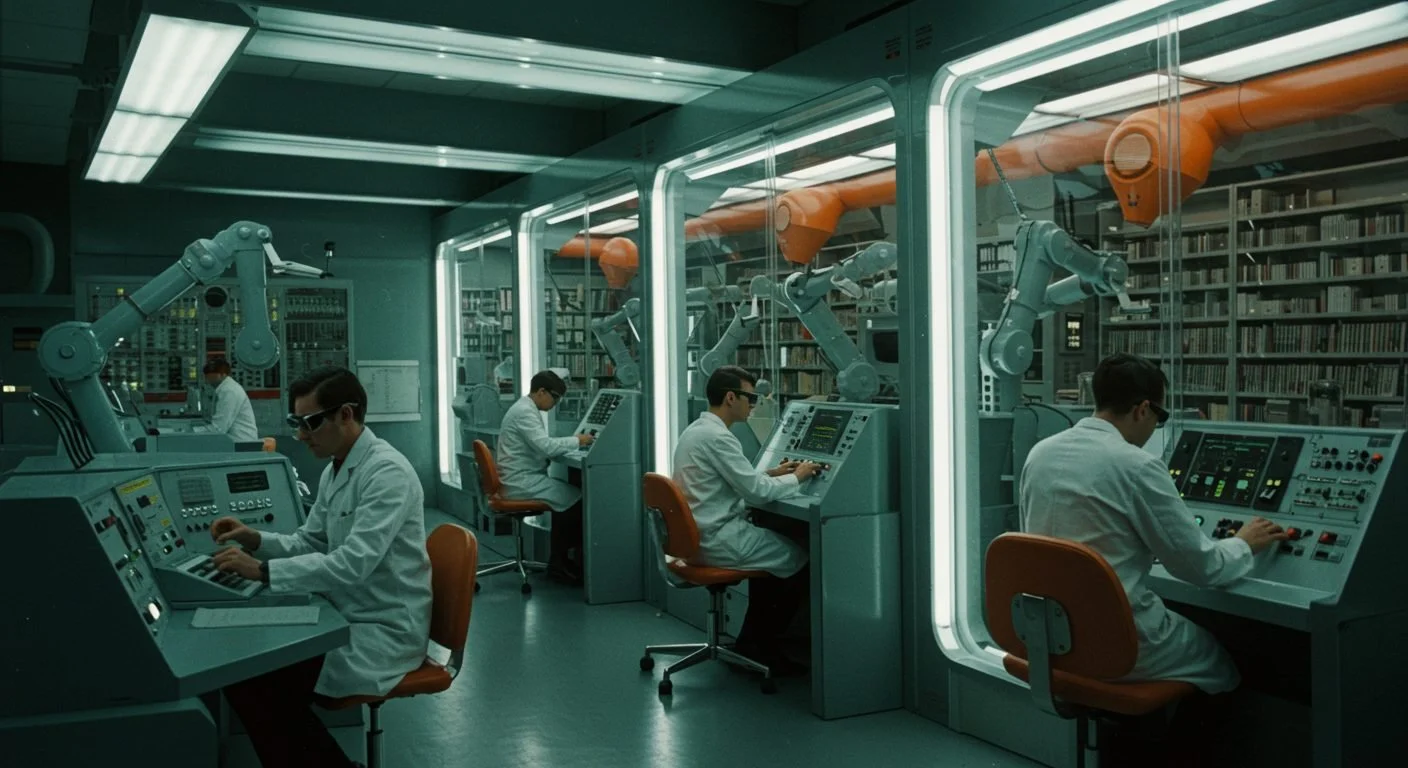
Stuart, thirty-three, works at the State University Library, where every recorded thing is kept in one building and no human hand touches a book. He meets his superior, Kasul, once. Kasul switches off the telecom, signs the card Stuart came for, and sends him off with one line.
“Tell your friend that the correct way to study the heavens is with the eyes shut.”
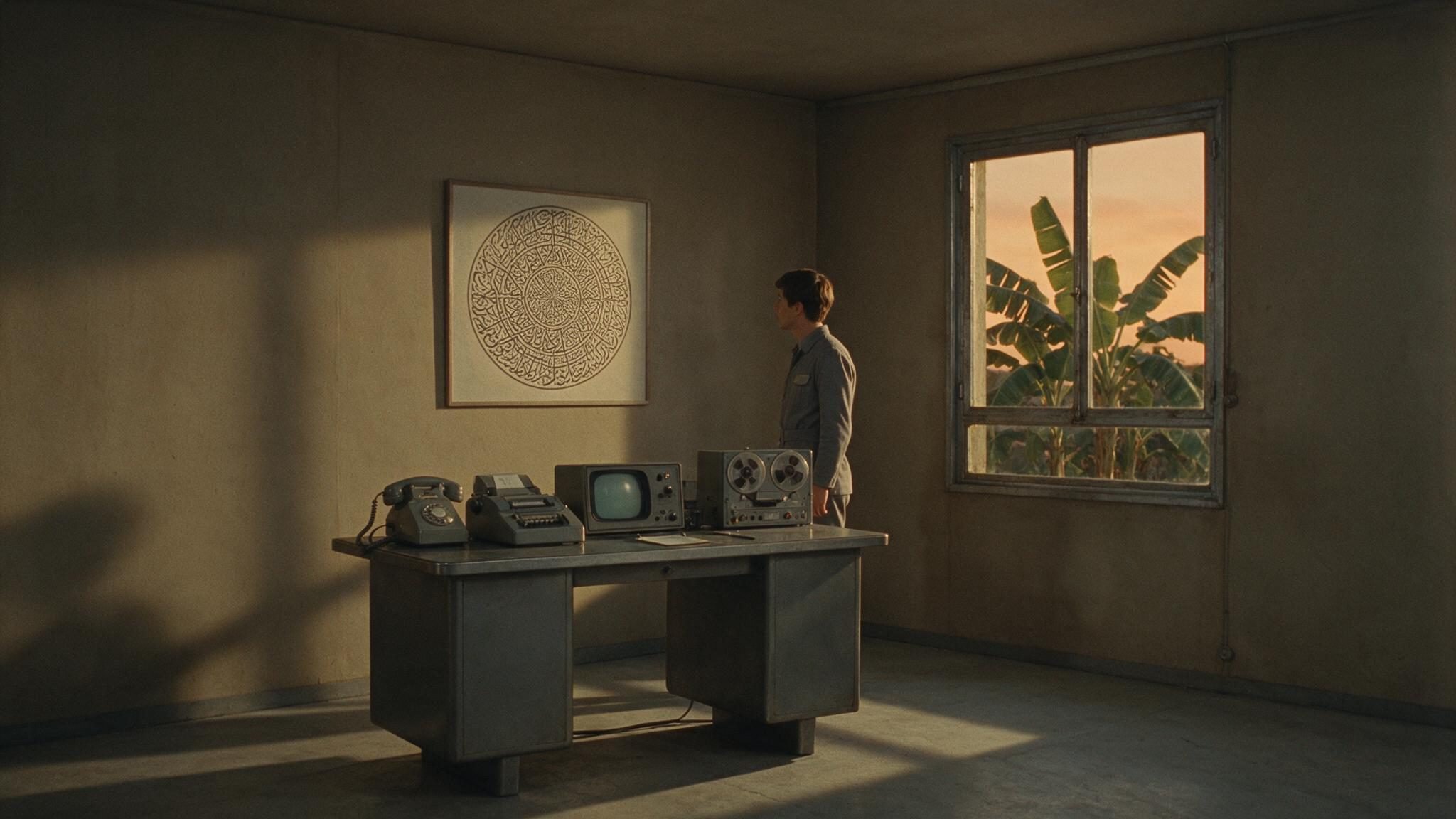
A month later Kasul is gone, his file closed. Stuart is given his office.
Kasul’s office
On the wall hangs a drawing, a circular maze in black ink. Stuart locks the door, switches off the telecom, takes it down and turns it over. On the back, in ink:
“This knowledge cannot be attained by seeking it, but only those who seek it find it.”Bayazid al-Bistami
He folds it into his inside pocket, next to the card Kasul signed. It stays there for the rest of the film.
Thursdays
For eleven years, four academics have walked into the Keeper’s house every Thursday with bottles: Aller the linguist, Gayen the psychologist, Axal the poet, and Zilla, a biologist and the best mind in the room. Stuart reads them the sentence. They tear it apart and enjoy it enormously.
Zilla
“You’re asking whether there’s a kind of knowing that doesn’t go into words at all.”
Zilla
“There is. It’s called an ecstatic state. There’s a very good literature on it.”
They leave delighted. Stuart stands at the window with his back to the room and cries.
The garden
At the bottom of the garden, under the banana tree, a heap of rags. A nomad. He does not get up.
Nomad
“Get me a glass of water.”
Stuart brings water and a plate of food and watches him eat.
Nomad
“You won’t find a camel in the donkey market.”
He wipes a tear from Stuart’s face and holds it up between finger and thumb.
Nomad
“This is the way to the camel market.”
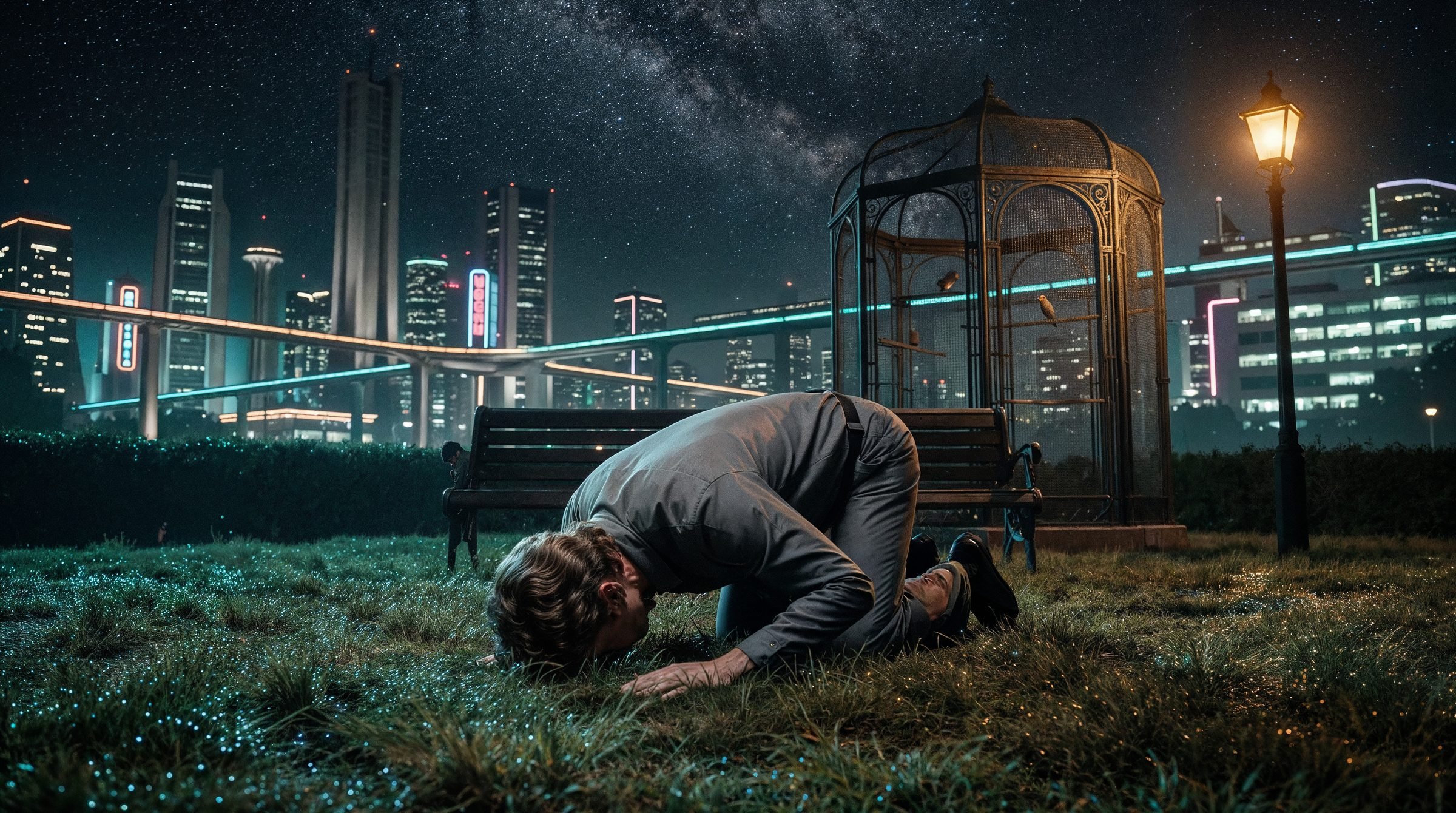
The aviary, at sunset
Nomad
“Put your head on the ground.”
Stuart
“There is no God.”
Nomad
“Quite right.”
Stuart
“Then why?”
Nomad
“Because that is surrender.”
Nomad
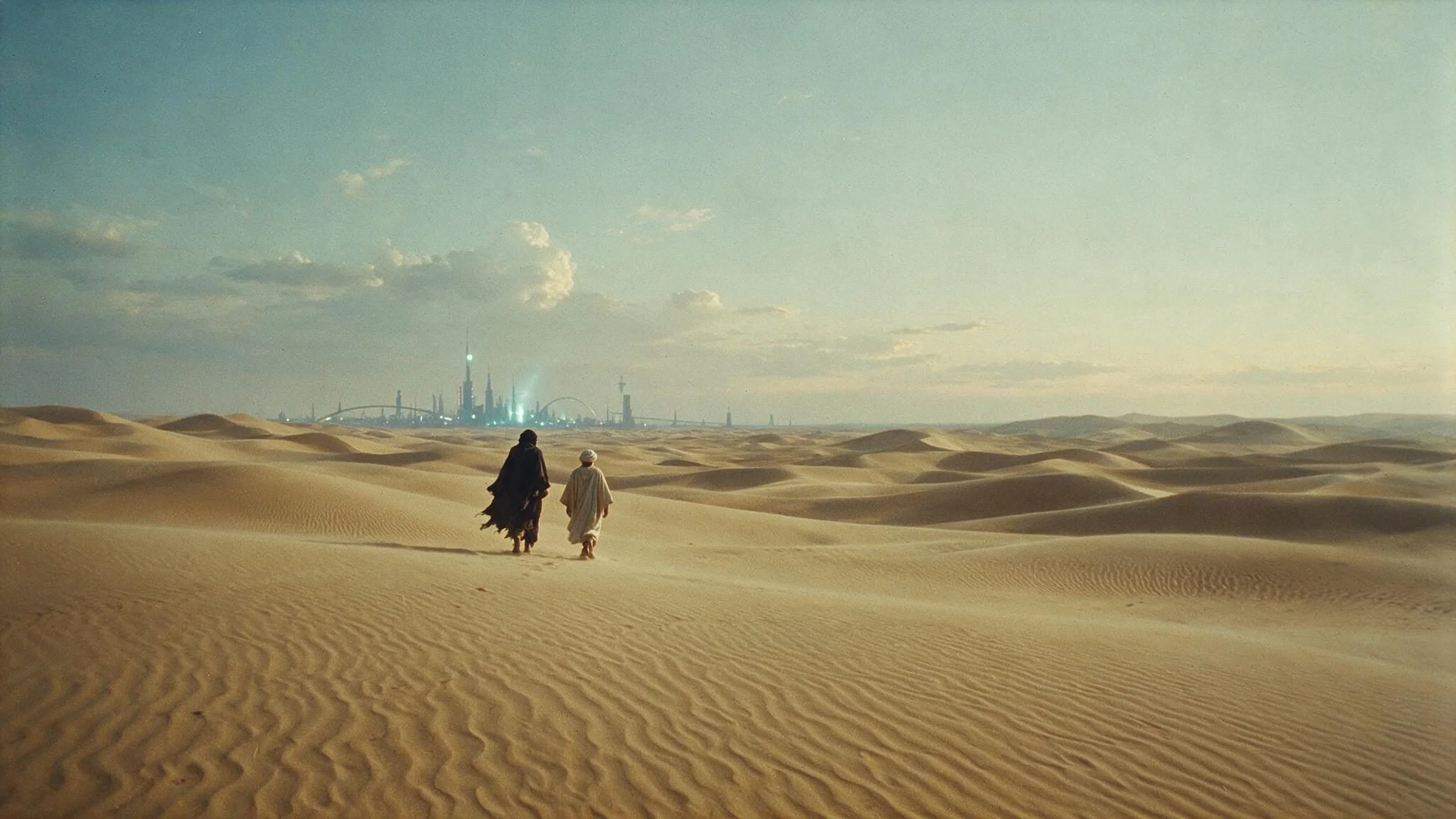
“Tomorrow at dawn I come to your house. We leave for the desert. You’ll need no passport and no money.”
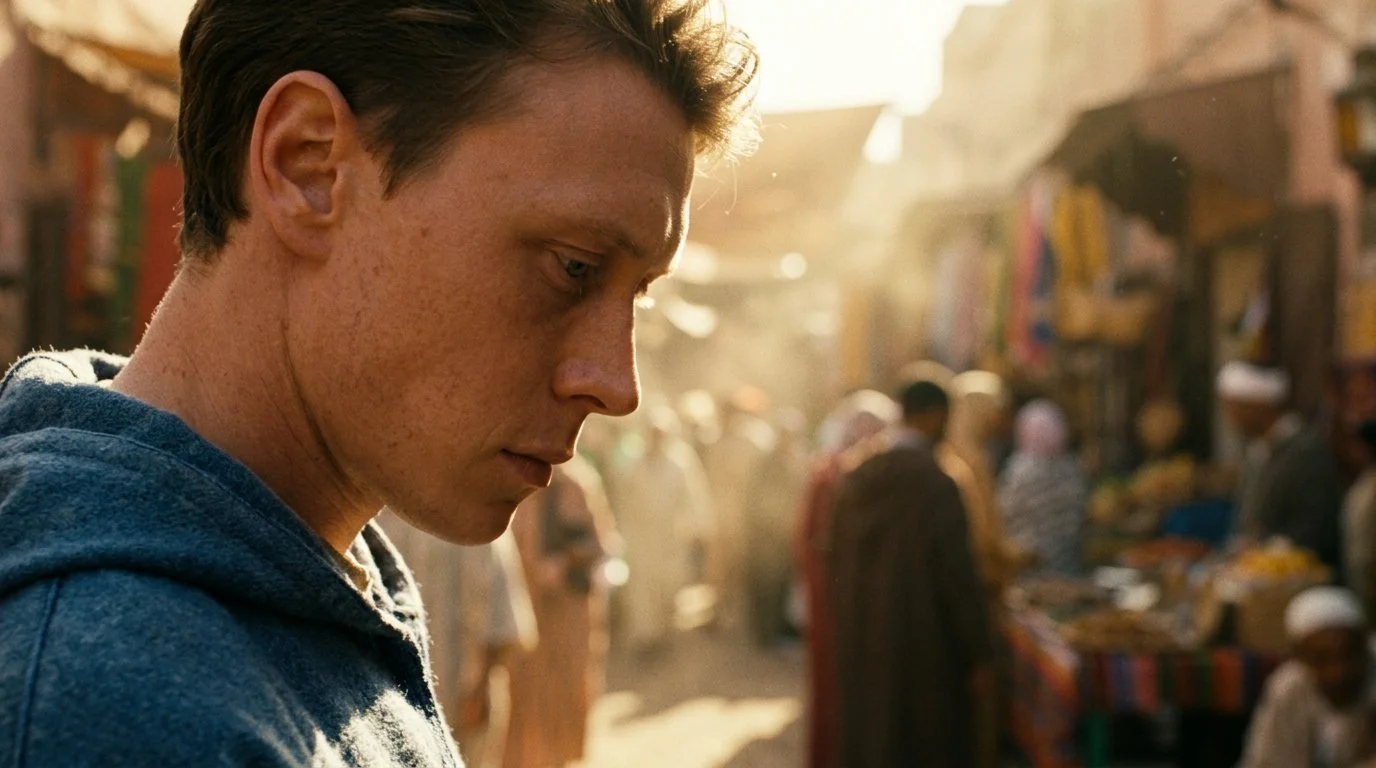
Stuart waits at his gate from dawn until dark. The nomad does not come. Stuart fills in a form at the Vacations Department: purpose of travel, holiday. A boat to the port of Azwan.
II
The Road
Azwan, a port on the edge of the desert. Nahb, a walled city a thousand years old with a minaret for every day of the year. Stuart carries a casebook of names and addresses, and the slip of paper from behind the picture. He is looking for Kasul.
Azwan
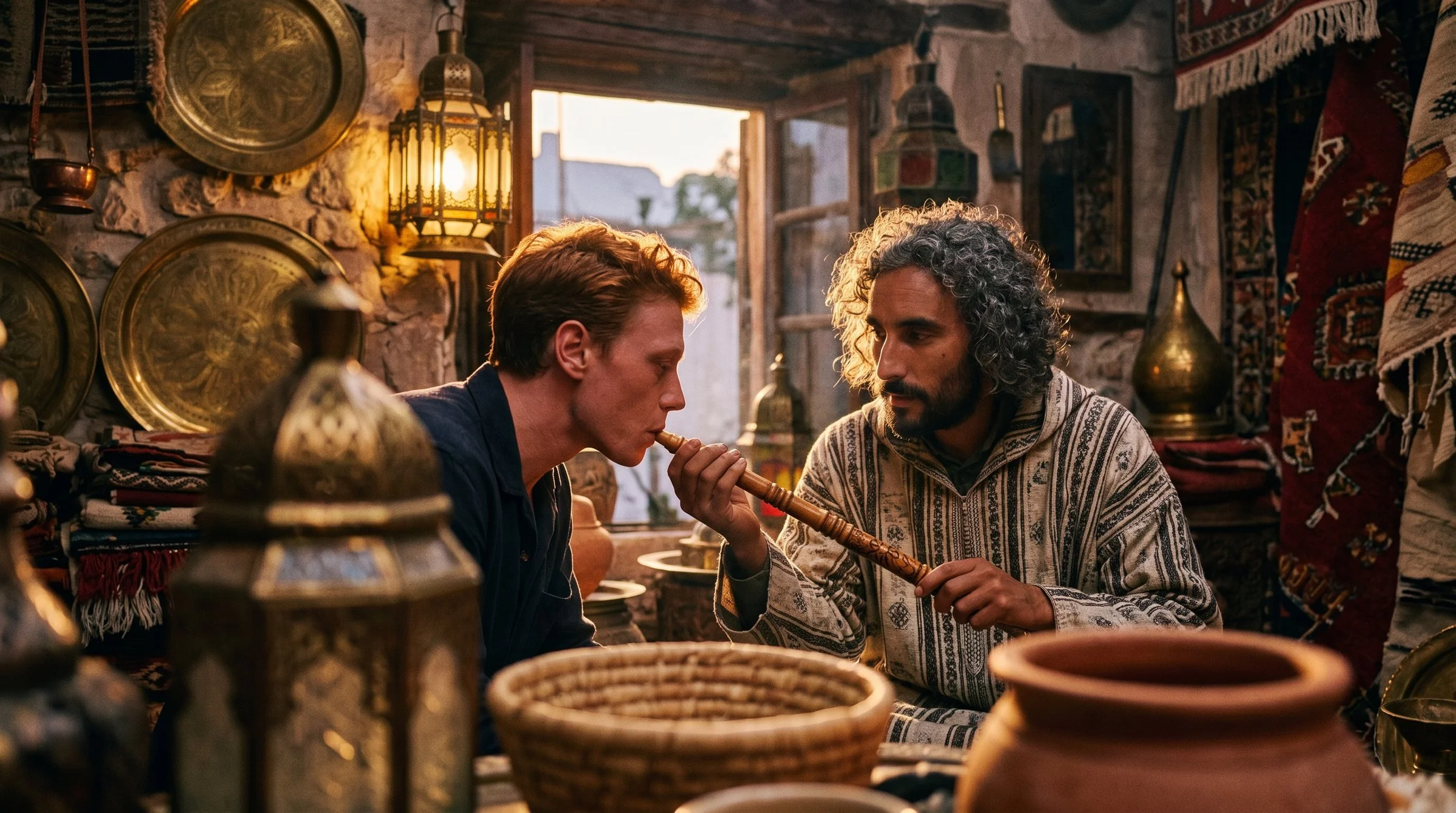
Nasir sells hashish at the top of a staircase lined with beggars. He knows where Kasul went and will not say.
Nasir
“It’s not for lying back stoned. This is hashish to see by.”
He taps his chest twice and says one word: Muslim. Stuart is offended. On the fourth morning he brings the hashish back.
Nasir
“You’ve given it up?”
Stuart
“No. It gave me up.”
The hill above Nahb
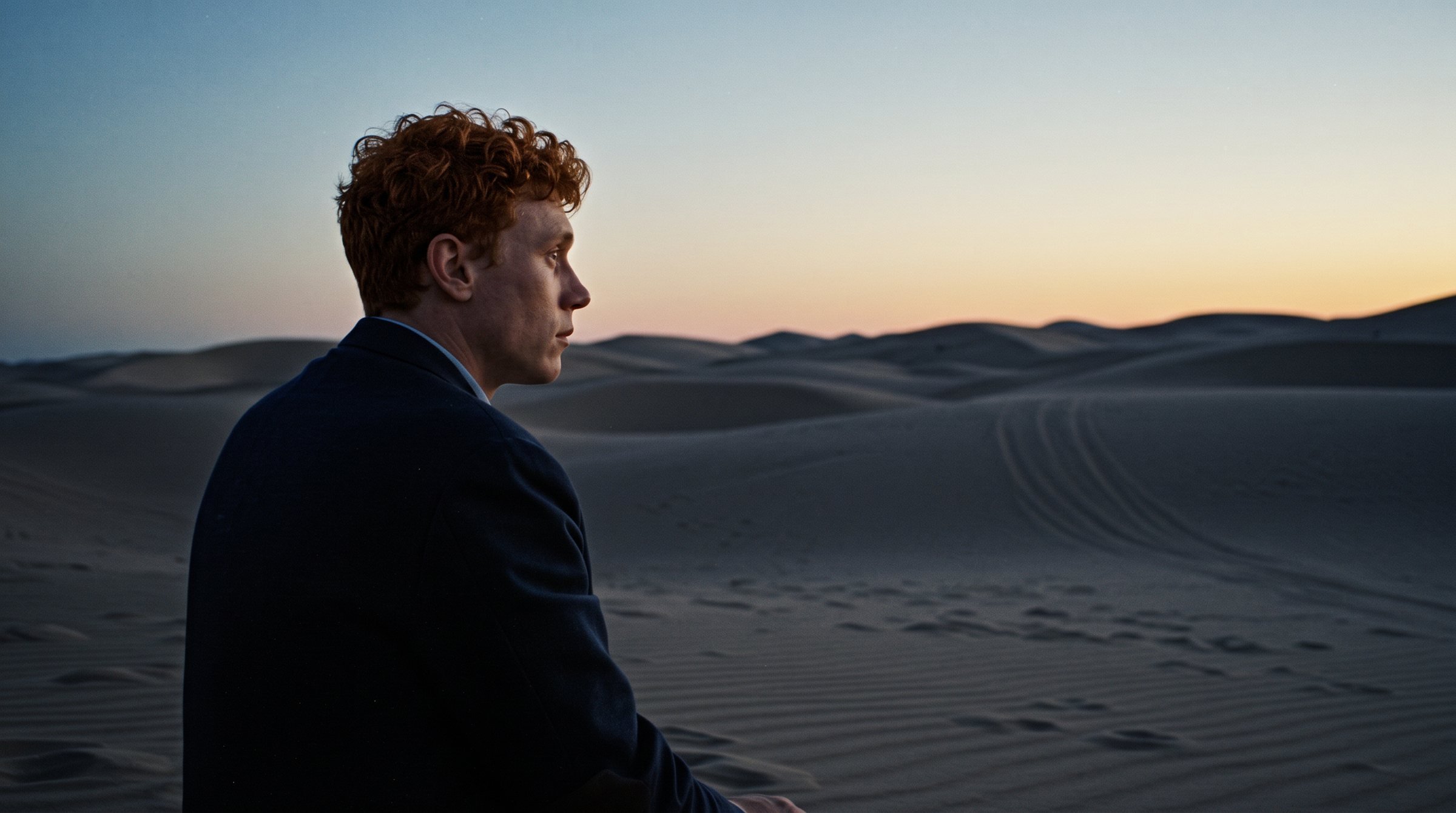
The call to prayer goes up from every minaret in the valley at once. Stuart opens his casebook to add a lead. The last entry is five weeks old.
He came four thousand miles to find a man, and somewhere he stopped looking.
This is where the film turns. His face does not show peace. It shows fear.
The Great Mosque, Nahb
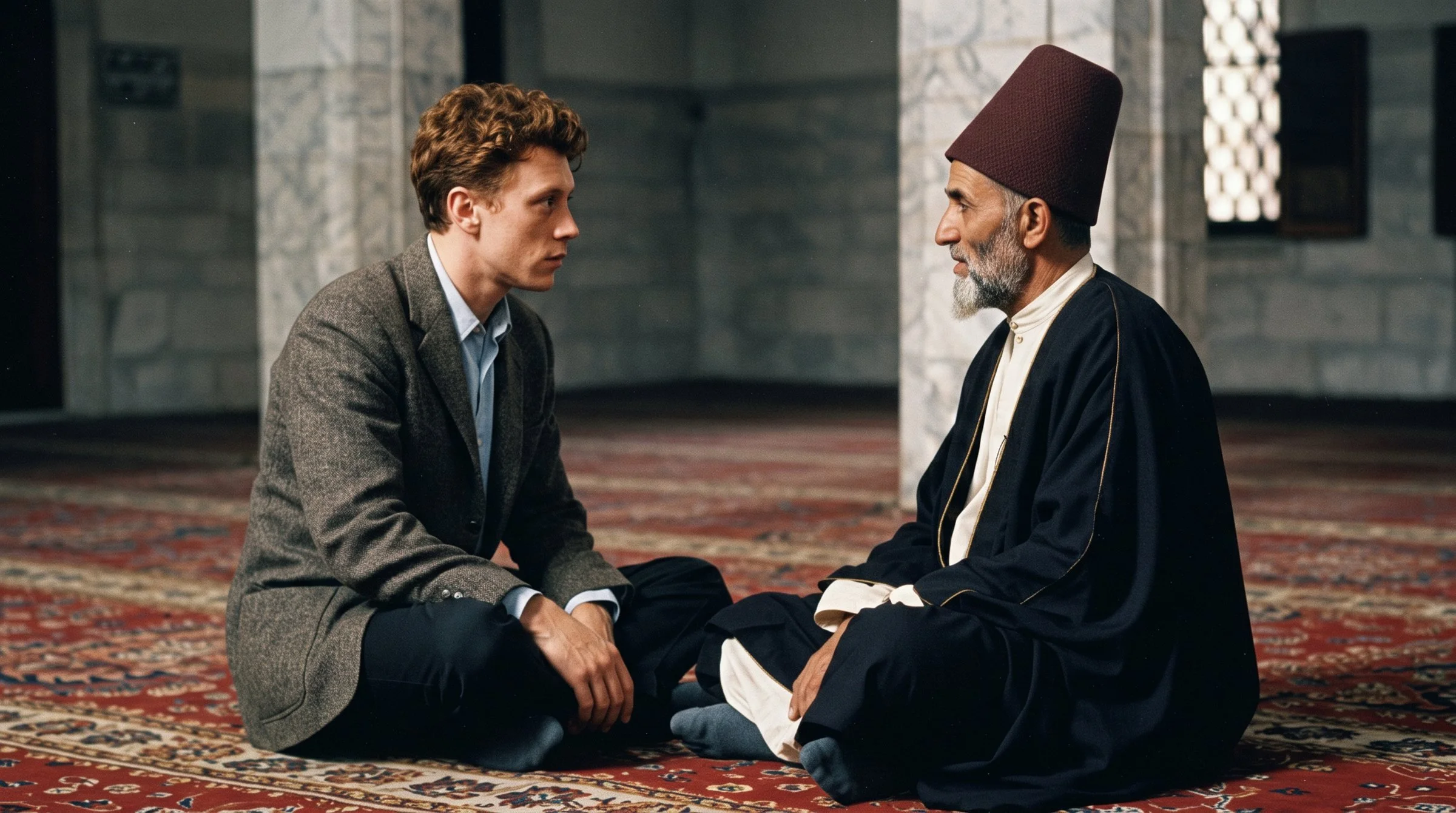
Stuart copies the men beside him, half a second late. Afterwards an old man sits down next to him.
Old man
“You must be anonymous. Invisible. Be the prayer. Turn away from yourself.”
Stuart stands in the line again, alone, and this time the floor comes up to meet his forehead. He becomes Muslim sober, in about four minutes, corrected by a stranger.
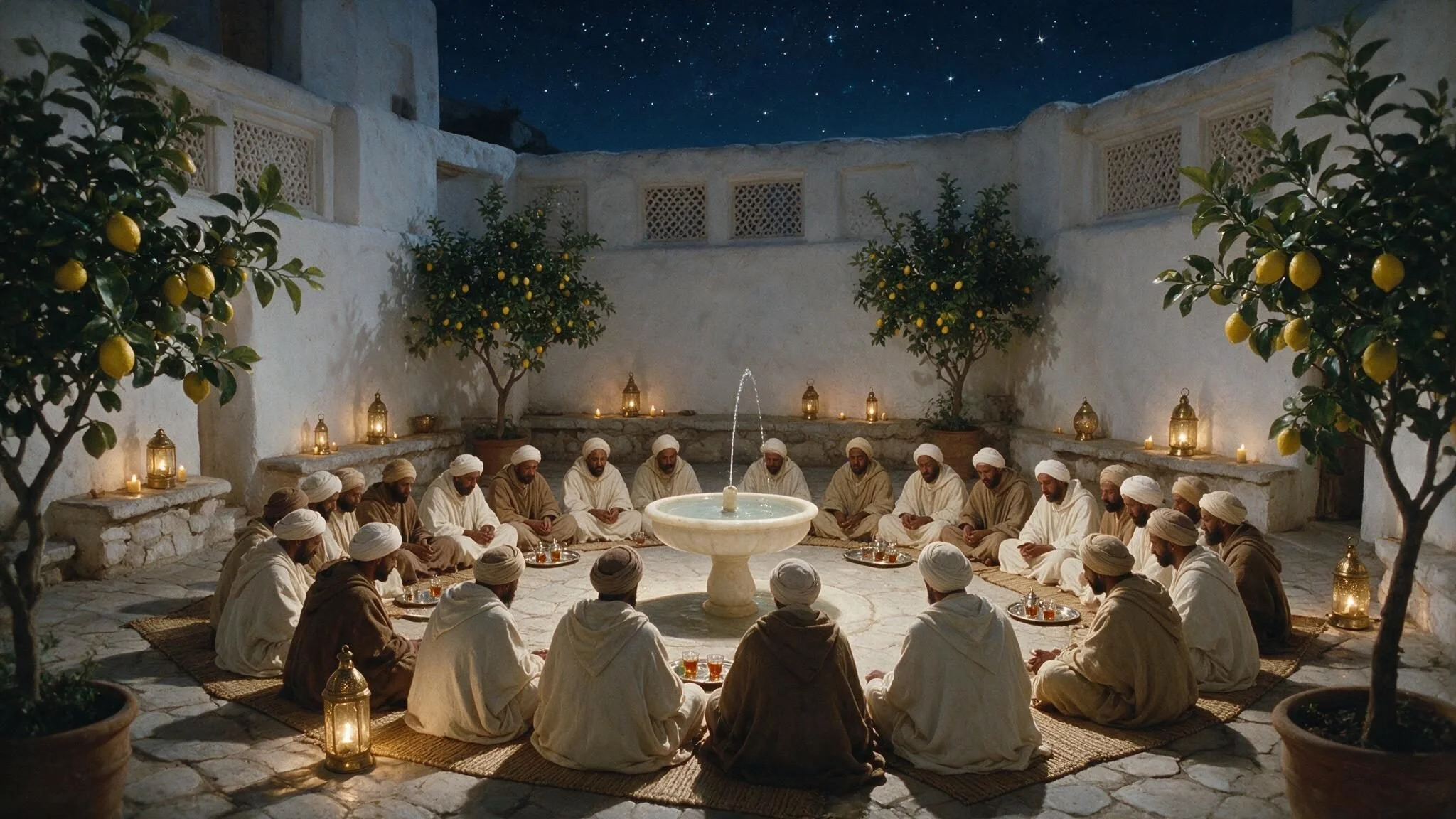
The souk, and a house in Nahb
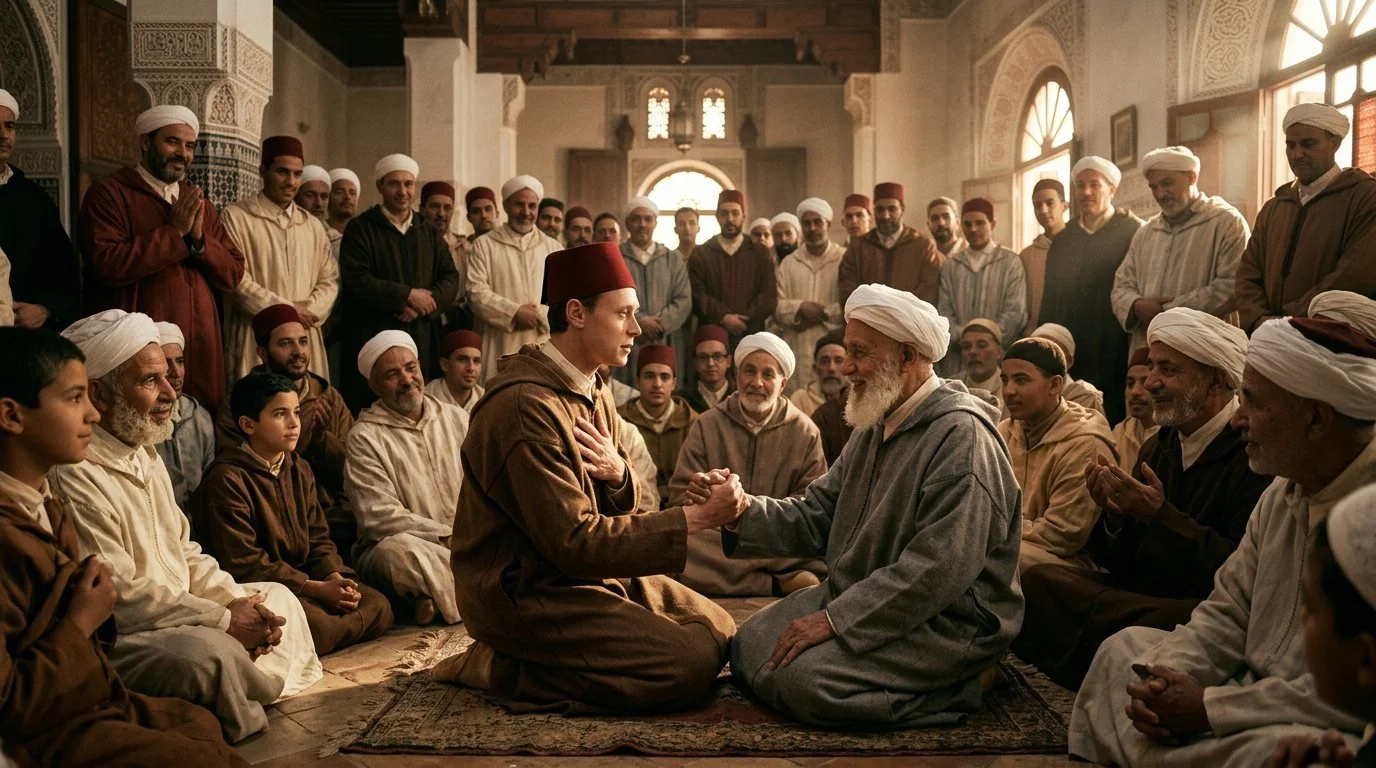
An old man in a pointed red felt cap drives his staff between the cobbles, and the crowd opens without noticing. Stuart makes a student stop him twice. The second answer:
Dervish
“I have nothing to say. To anybody.”
On Thursday, in a courtyard of lemon trees, thirty men sing. The dervish shoves into the circle and takes Stuart’s hand. Something goes up his arm into his chest and nearly puts him on the floor.
III
The Zawiyya
Othman, a lecturer from Stuart’s own university, has also become Muslim. Together they chase the Shaykh down the wrong roads all day and miss him everywhere, until his car turns the corner. He is over a hundred years old.
The Shaykh
“Follow my car. You’ll come back to the house as my guests.”
عبد الله
The guardian
At the green door a man takes the bags out of their hands before they can object. He has lost an eye. He never looks up. Stuart barely notices him. For four months Abd’Allah carries, fixes and sweeps, at the back of every shot.
One afternoon Stuart tells him about the Library, the tape spools, and the man who ran it and walked out of his house one day.
Stuart
“Kasul. His name was Kasul.”
Abd’Allah does not move. Then he puts a broom in Stuart’s hands and goes. The audience laughs. It is the fourth time.
The first lesson
Breakfast
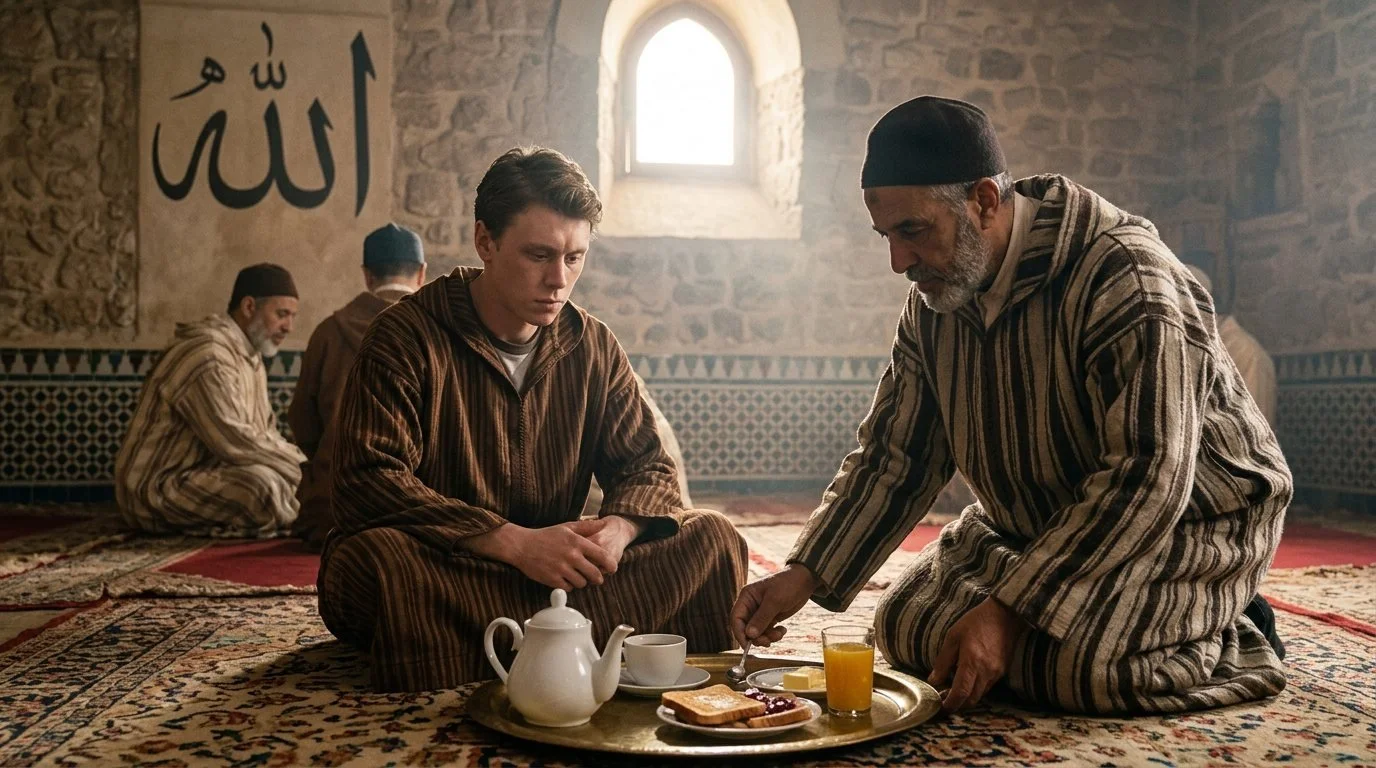
Every morning Stuart slips out to a café for toast and conserve. When a faqir asks him about it, he makes a reasonable, furious speech about privacy and grown men. In the middle of it the faqir begins to sing, and ten men sing at him. The next morning he stays. On the tray: a fresh loaf, butter, thick fruit conserve. Nobody touches it until the guest opens the meal.
Bismillah.
Six gatherings
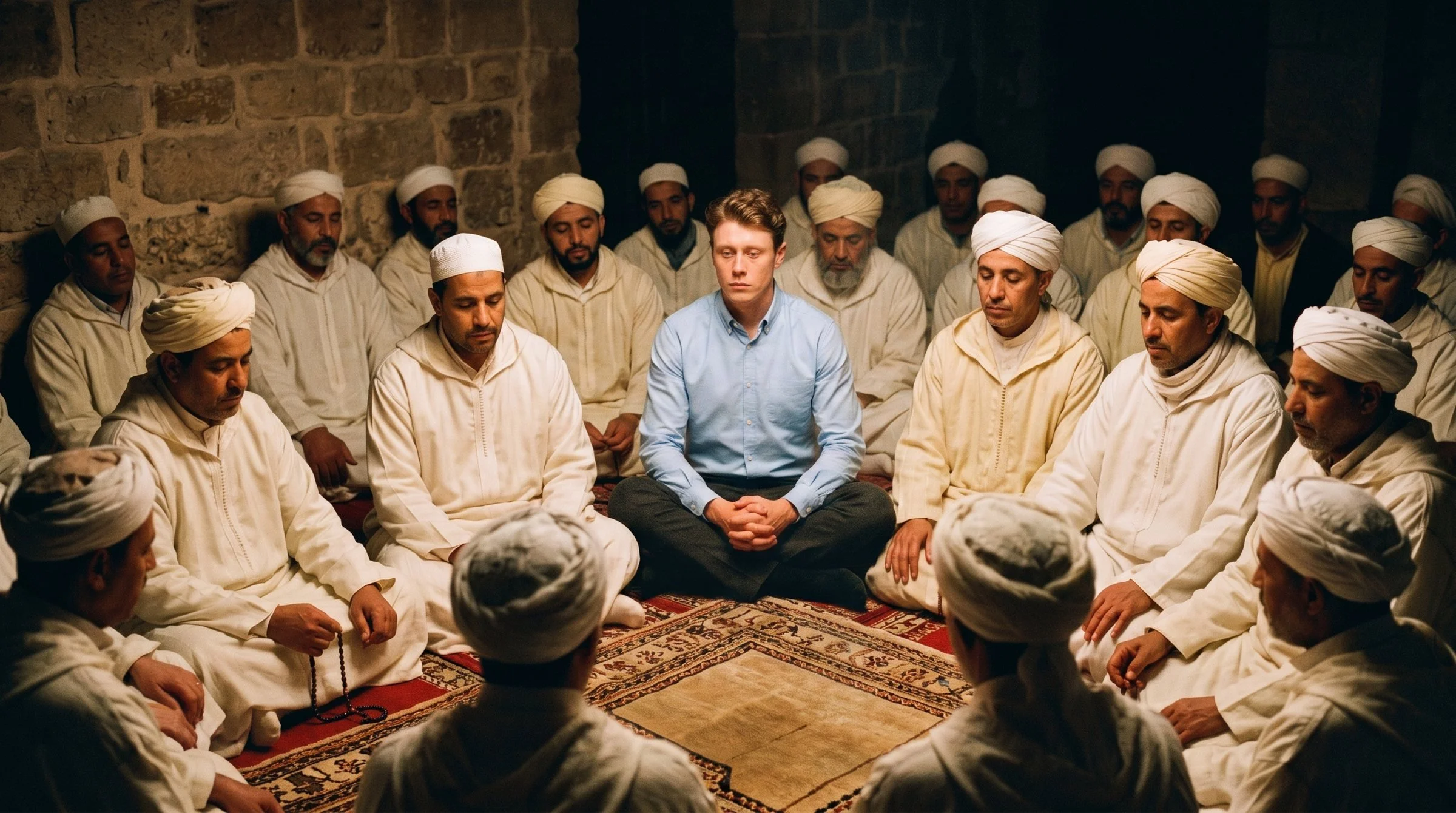
He starts at the Shaykh’s right hand. Over six gatherings he drifts to the doorway, with people stepping over his feet. Nobody moves him. Nobody mentions it.
In a labourer’s flat in the shanty town of Wisal, jammed into a corner, he stops fighting, and it happens. At the Master’s table he gives the finest grapes to an old mountain man beside him. Across the table, the Shaykh’s hand puts larger grapes into his.
The recoil
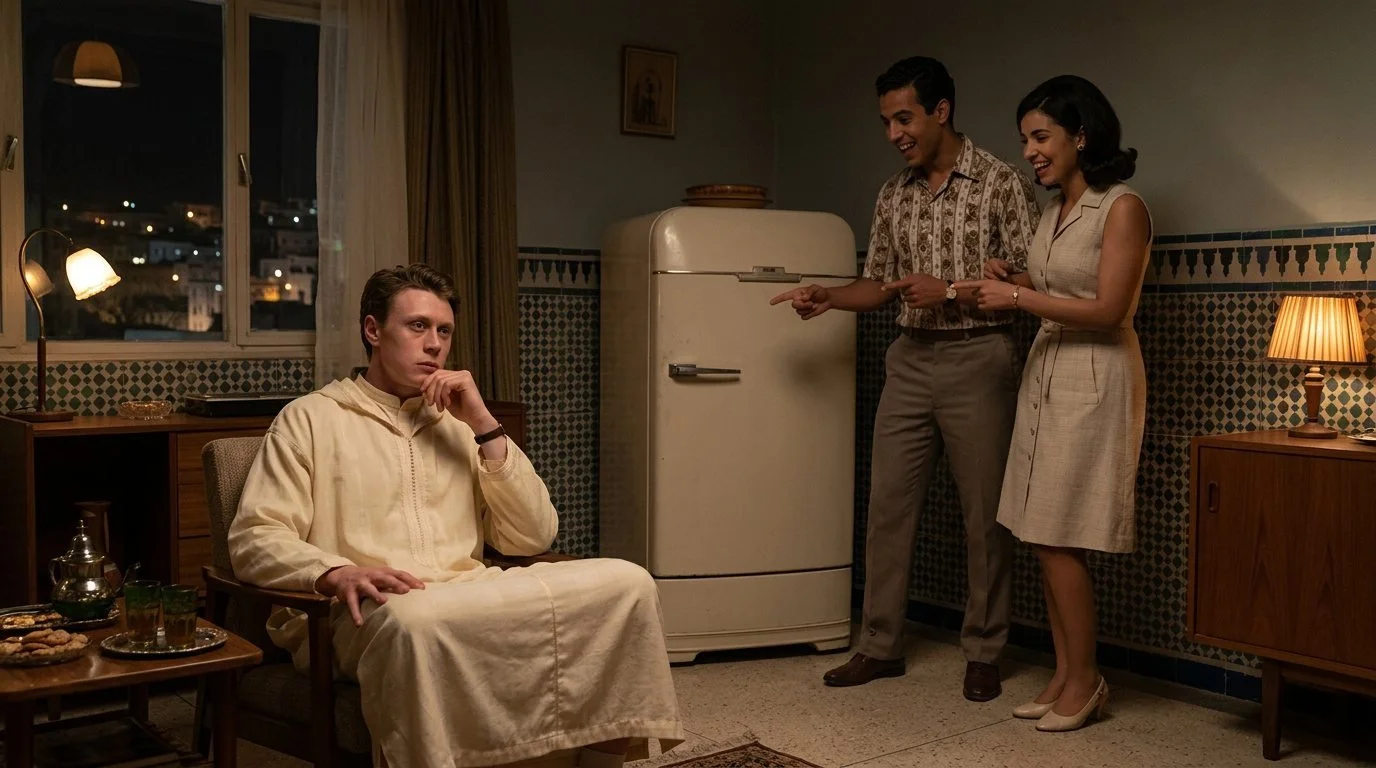
No summons follows. Stuart skips the gathering, eats the most expensive cake in the café, and goes home with a student whose refrigerator is opened twenty times while supper is made. The television stays on. His young wife is a schoolteacher; they are saving for a better life and it is ruining them.
Two miles away, in a shanty mosque, is everything Stuart came for. He cannot give it to them. He hasn’t got it yet.
The roof, and a cup of coffee
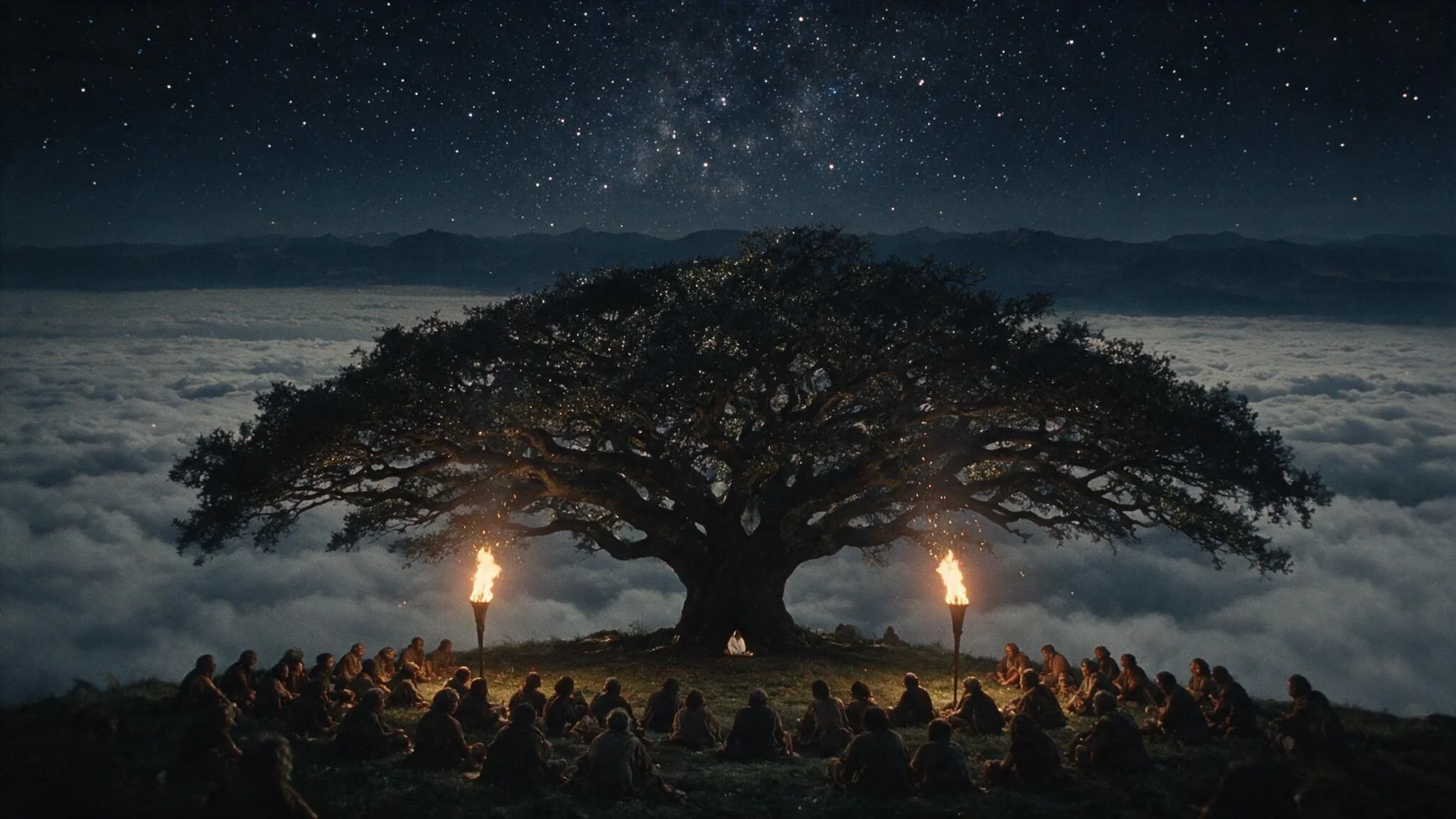
He spends a night in prayer on the roof against the Shaykh’s wall, waiting to be seen, until even that goes. At dawn the car is waiting. He kneels in the road and kisses the old man’s hand.
The Shaykh
“You must be careful at nights. You’ll catch a cold.”
Another morning his coffee never comes and he cannot do his practice for rage. The Shaykh appears in the doorway with a steaming glass.
The Shaykh
“Bismillah.”
Part of the way
Othman goes home. “It isn’t my road. Or it isn’t yet.” Stuart watches the car to the corner. Then a man comes in from the road, salutes him, prays, and sits down opposite. The nomad.
Nomad
“I said I’d take you part of the way.”
He takes a glass and a jug. The glass can know only up to its rim. He pours, and does not stop when it is full.
Nomad
“But look. This can fill this.”
The great feast
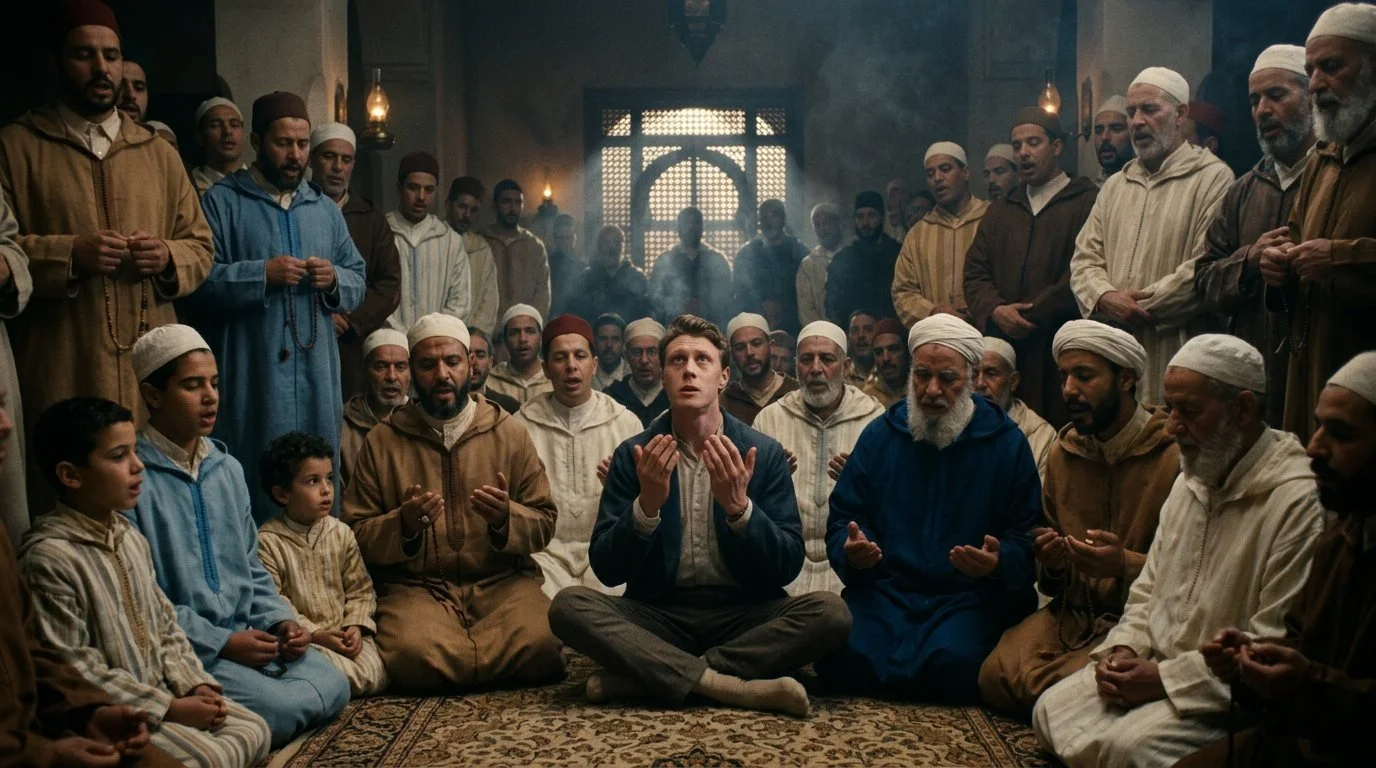
Three hundred people, fed from a kitchen the size of a bathroom. Abd’Allah stands over Stuart with a basket, puts a glass of tea in his hand, and for the only time in the film looks him in the face.
Abd’Allah
“You are now afloat on the deepest sea. And between you and the ocean there is only this frail little boat. Yourself.”
Across the room a voice recites: truly, with hardship comes ease.
بركة محمد
The ending
Back in Kasul’s office, straight from the airport. The maze on the wall comes apart into Arabic letters, and Stuart, who has spent a year learning them, reads it: Barakatu Muhammad. Abd’Allah’s parcel holds a handwritten book. On the title page: The Book of Strangers. Stuart lays the slip from behind the picture beside it. The same hand.
The man he crossed the world to find carried his bags.
Over it, from a bare office a year and a lifetime ago: “the correct way to study the heavens is with the eyes shut.”
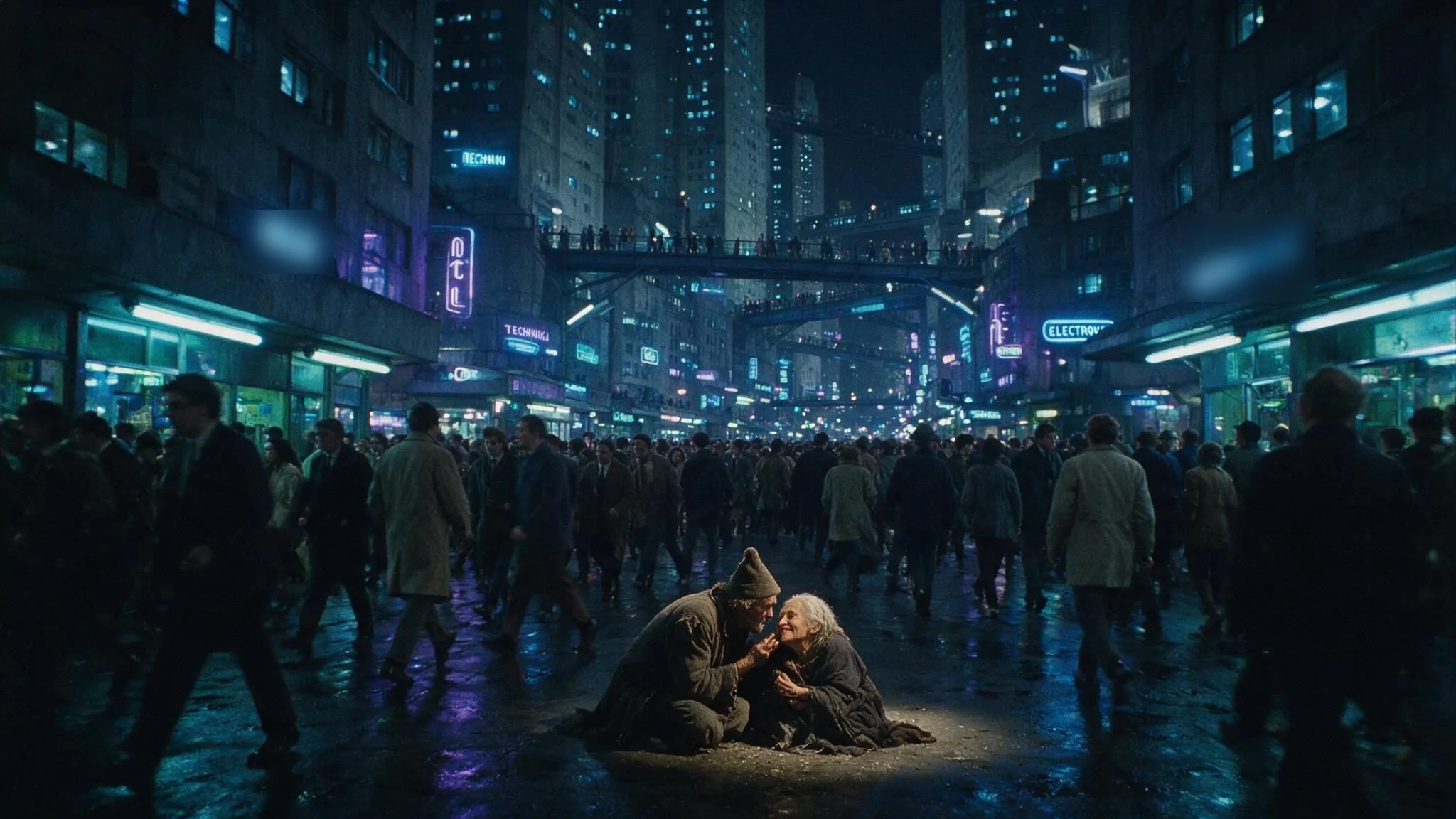
He turns the page
A ruined city at the end of the world. Two old women in a doorway, watching it.
Second woman
“I remember, when I was a young girl, a strange man came to our city, begging. He was in rags, like us. And he wore a pointed cap.”
Second woman
“I can still remember the peace in his eyes when he put his hand on my arm.”
Themes
What the film is about
Knowledge without wisdom
A civilisation that has archived everything and understands nothing. “They teach, but they know nothing. They think, but they do not reflect.” Written in 1972 about cassette tapes, it reads today as a description of learning through machines.
The seeker and the sought
Every search in the story turns over. Stuart hunts a man and is found by a master. He hunts the man for months, and the man carries his bags.
Poverty as wealth
Every holy figure in the film is a beggar. The state’s cathedral is a library nobody reads. The film’s is a shack in a shanty town, with a wooden minaret nobody can climb.
The dismantling of the self
The third act’s plot is an ego being worn down by breakfast, seating arrangements, a cup of coffee and a broom.
Why now
Written in 1972. Set in the world we live in now.
The novel describes a society that has replaced reading with machine-processed information and built a psychological apparatus to keep its citizens inside productive patterns of thought. We are the first audience for whom that is not speculative fiction. Everyone in the cinema will recognise the Library, and that recognition earns the film its question: if machines can now do our knowing for us, what was knowing ever for?
There is also a gap. Serious cinema about Muslim spiritual life, made from the inside, without terrorism and without triumphalism, barely exists in international arthouse. This is that film, from a classic source, with a science-fiction hook that gets it seen.
The State
Cold, symmetrical, fluorescent. Muted Technicolor, hard verticals, monumental rooms with nobody in them. The future as 1967 imagined it: tape, cathode tubes, punch cards, concrete. No flat screens. No phones.
Alphaville · Fahrenheit 451 · Severance
Morocco
Heat, dust, candlelight, textiles, faces. Wide, static frames give way to close-ups. The film warms up as it goes.
Stalker · Of Gods and Men · The Sheltering Sky
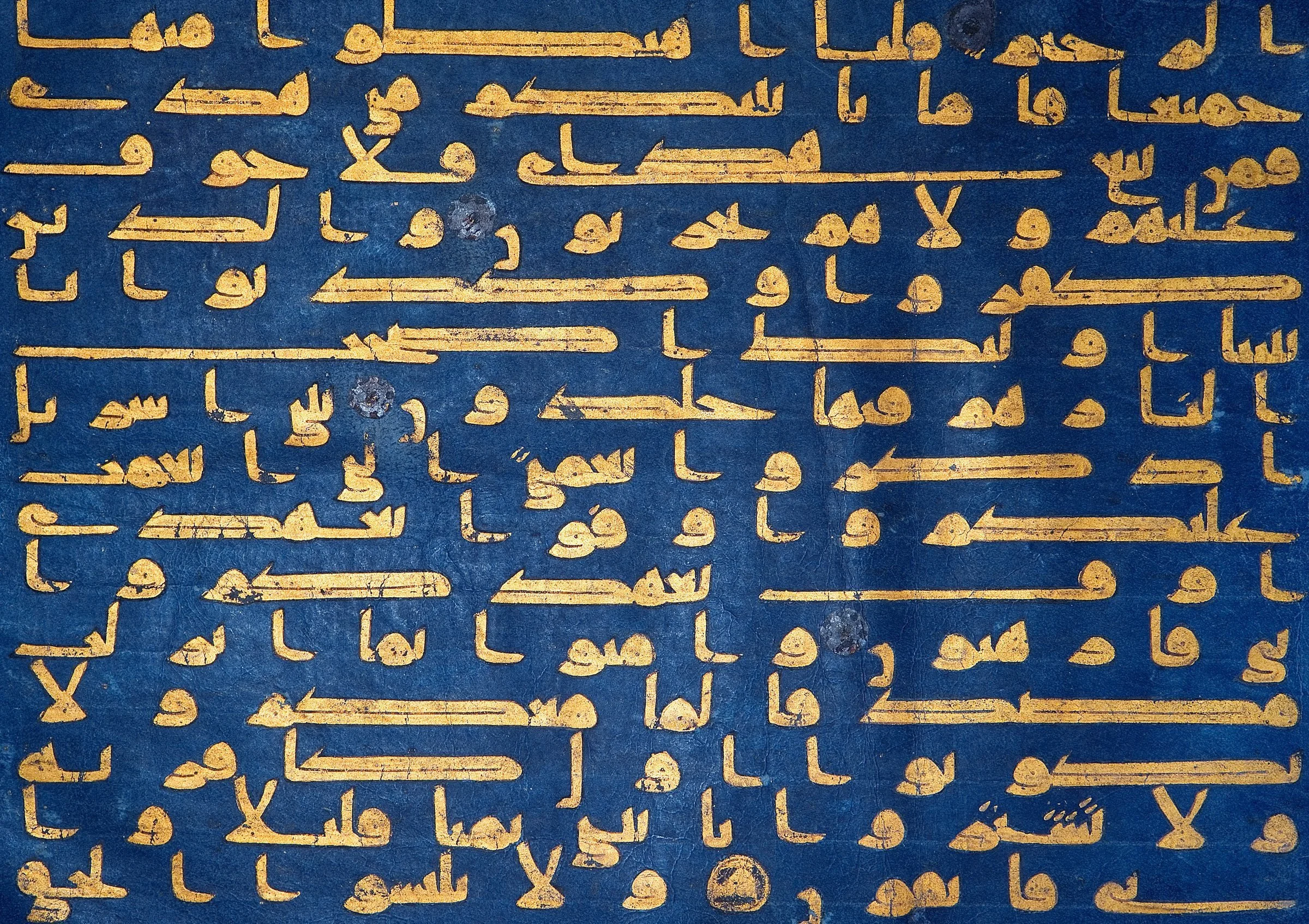
Sound, language and the sacred
Sound
The Library hums: servers, ventilation, tape. Then wind. Then the human voice: the call to prayer, recitation, a hundred men singing. The dance is withheld for most of the film and arrives as the loudest thing in it.
Language
Act one is in English, the flat register of the state. Arabic enters as noise, then as prayer Stuart is learning to say, then as the language of everything that matters. By the end his English voice has almost gone. Fully subtitled.
Restraint
Miracles happen and are never proven. The car turns the corner at the right moment. The coffee comes before it is asked for. The Shaykh knows about a vigil he could not have seen. Any sceptic can explain all of it, and we keep it that way.
Characters and casting ideas
The strangers
Casting ideas only. No actor is attached. Images are concept art made with AI.
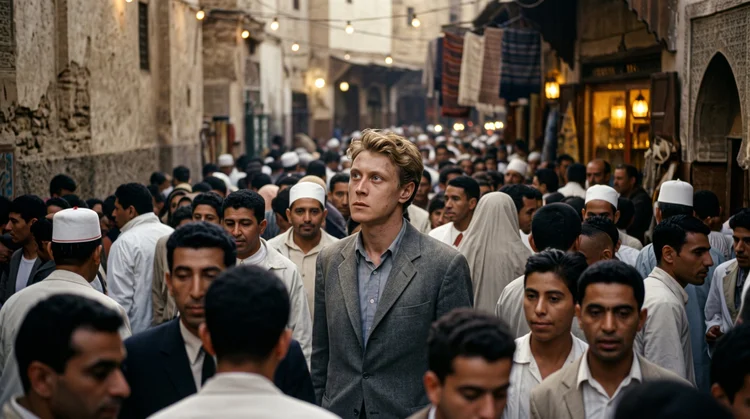
Stuart
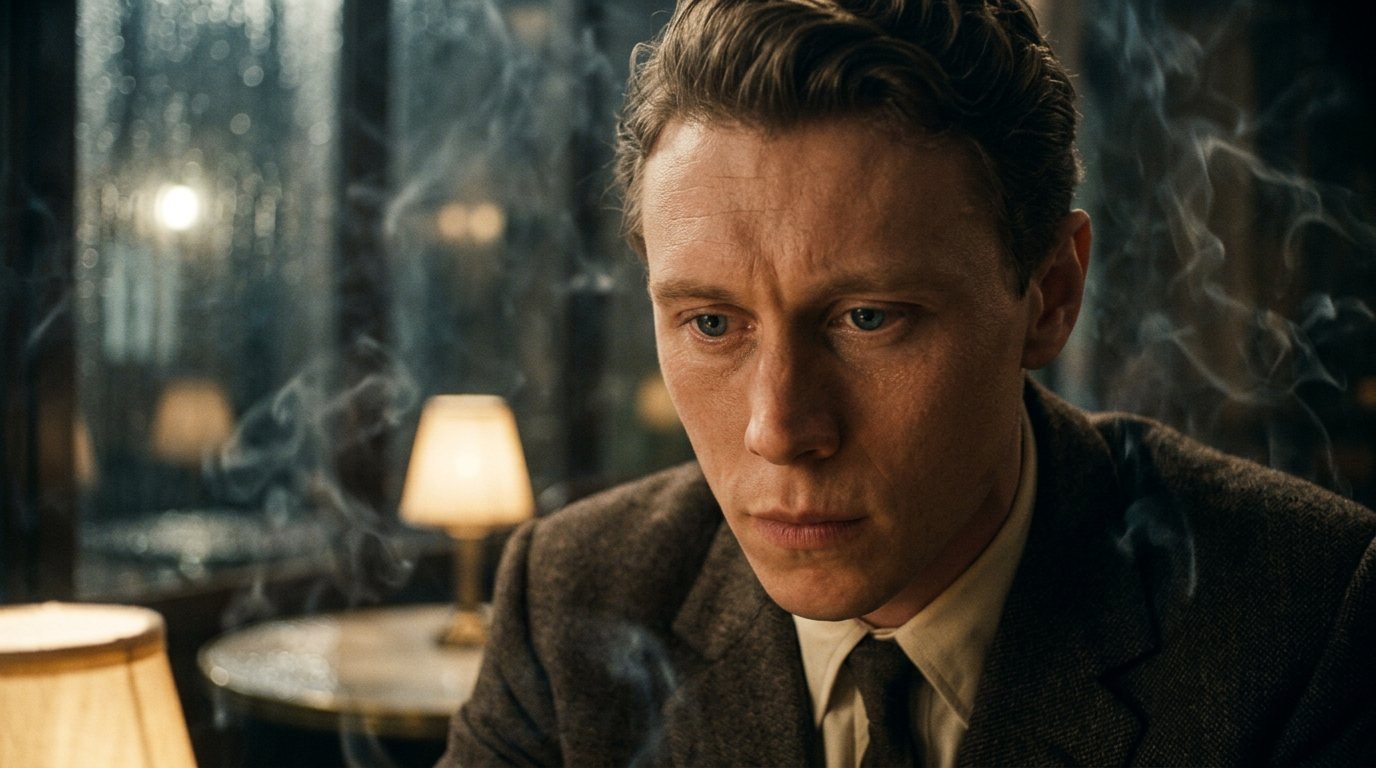
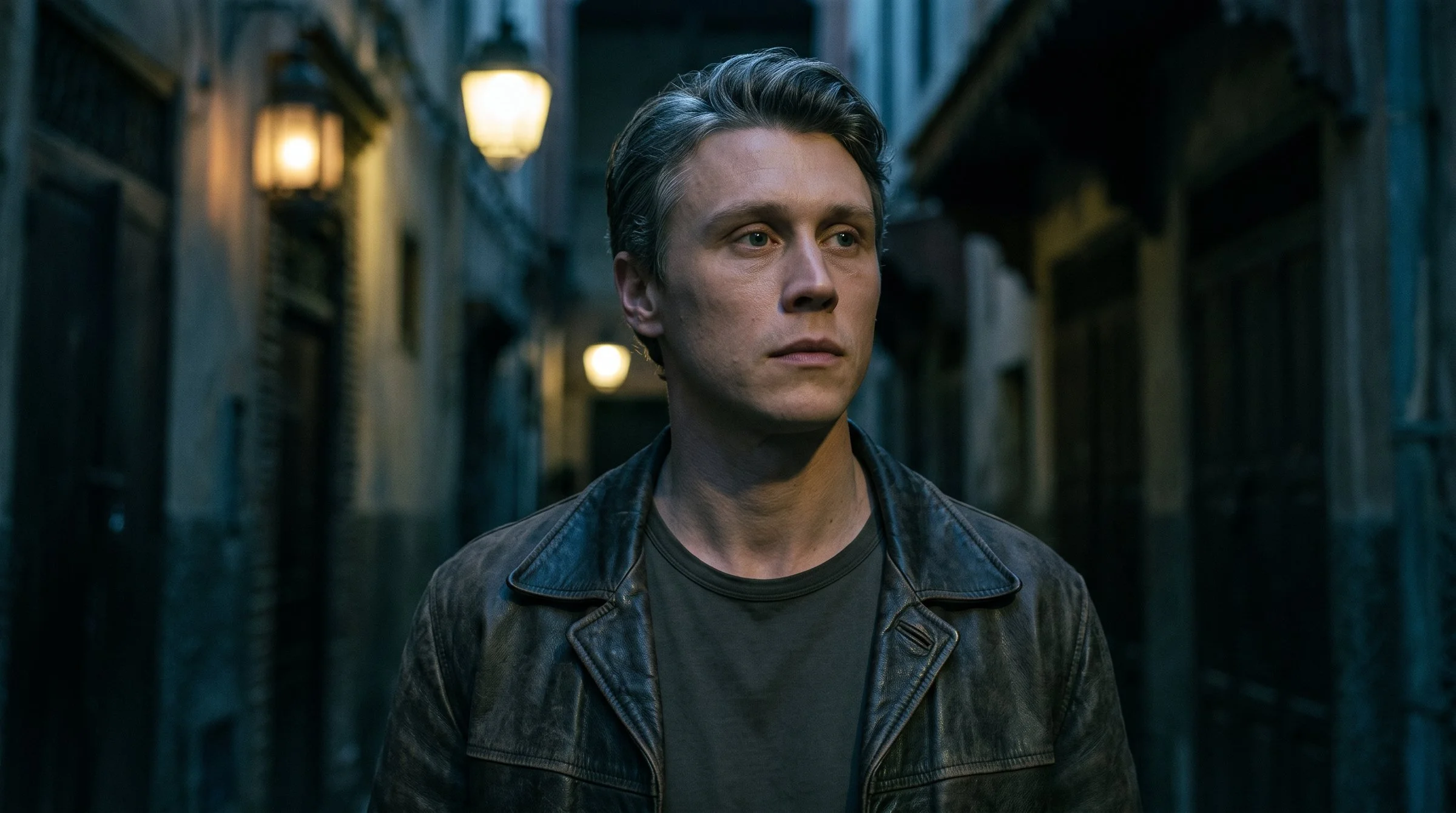
George MacKay
Records specialist of the state. Rational, restless, proud of his mind. In nearly every scene. His conversion is the film.
Kasul / Abd’Allah
Alexander Siddig
The Keeper of Archives, and the one-eyed man who sweeps the floor. One actor, unrecognisable in between.
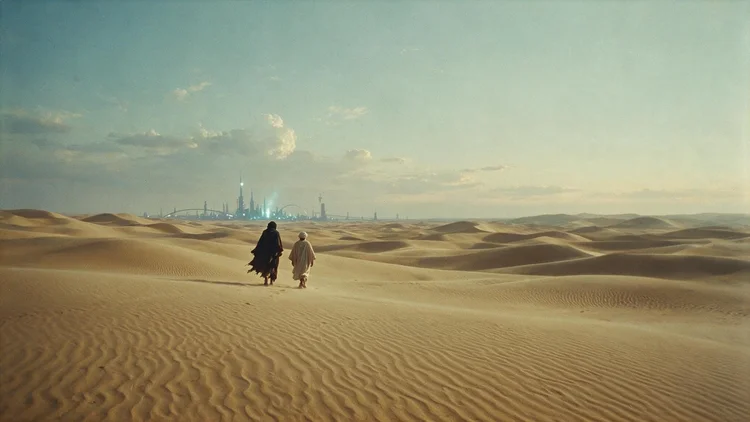
The Nomad
Slimane Dazi
Asks for a glass of water and takes Stuart part of the way.
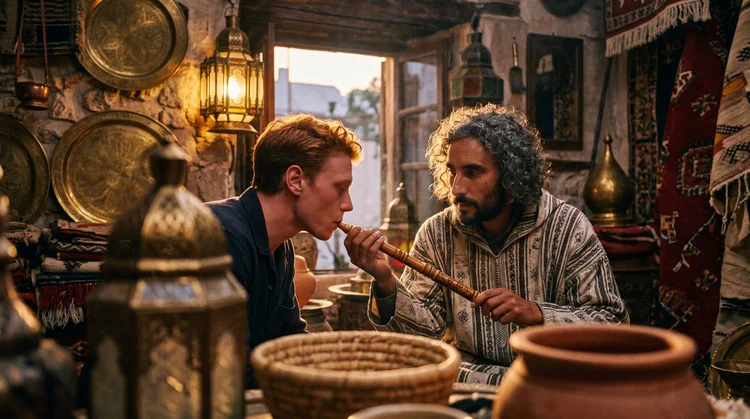
Nasir
Anuar Khalifi
Hashish merchant of Azwan. Roguish, stoned, holy. Says the one word.
Zilla
Tilda Swinton
The best mind at the Thursday table, and the only one who hears Stuart before she files him away.
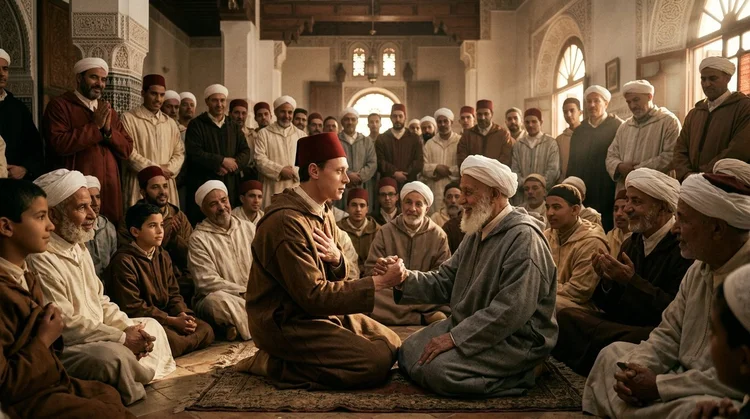
The Shaykh
From within the tradition
Almost silent. Teaches through timing. Cast from within the tradition, face largely withheld.
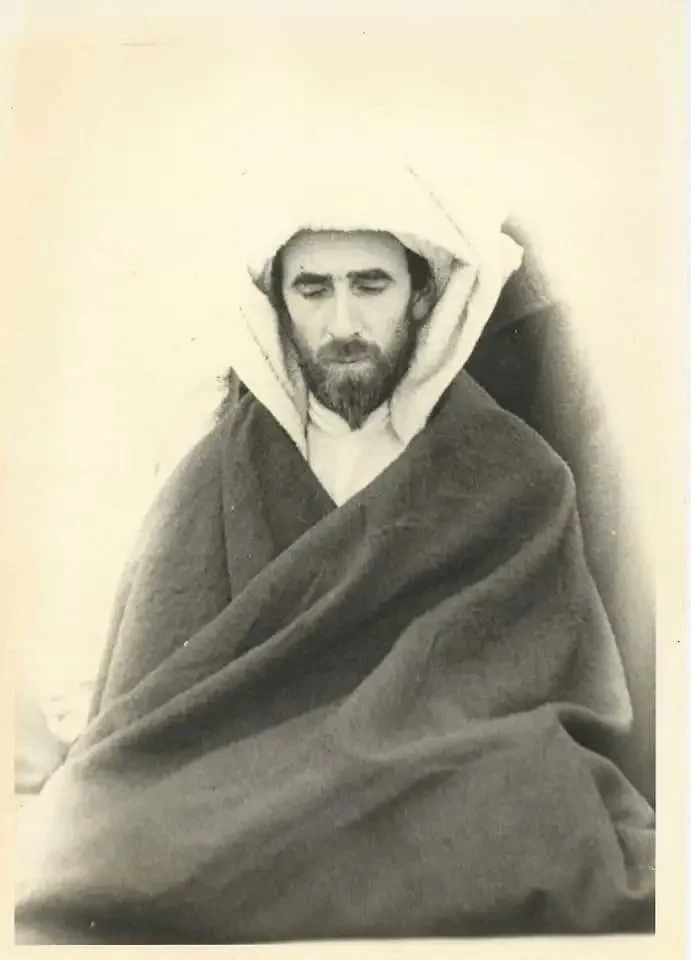
The author
Ian Dallas 1930–2021
Born in Ayr. Trained at RADA, adapted Troilus and Cressida for the BBC in 1954 and wrote television drama until the mid-sixties. Acted for Fellini in 8½. Gave Eric Clapton a copy of Nizami’s Layla and Majnun; Clapton wrote “Layla”.
In 1967 he became Muslim at the Qarawiyyin in Fez. The Book of Strangers followed in 1972, from Gollancz in London and Pantheon in New York. The Shaykh at its centre is his own teacher, Shaykh Muhammad ibn al-Habib, to whom the book is dedicated.
As Shaykh Abdalqadir as-Sufi he taught for more than fifty years. He died in Cape Town in 2021.
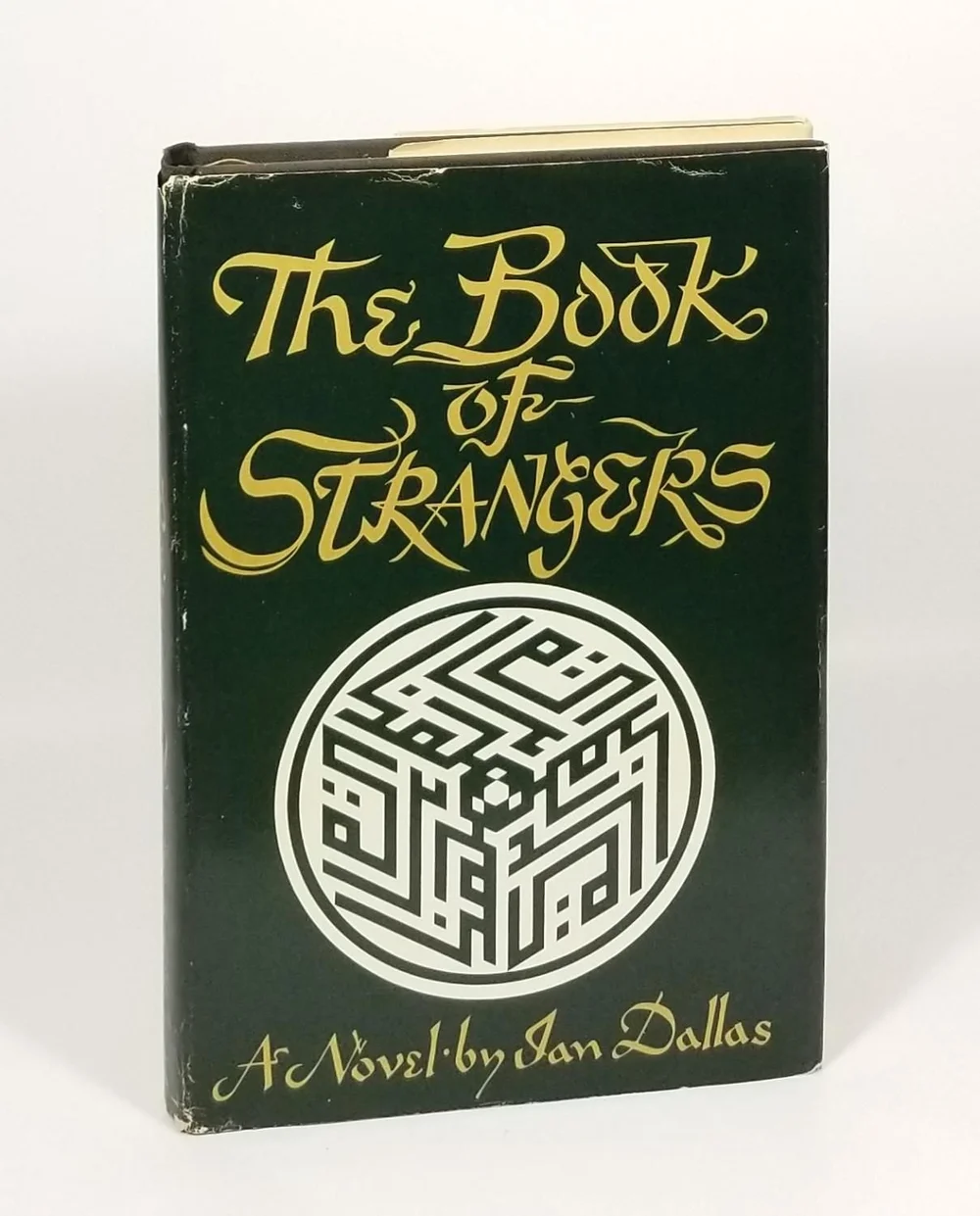
Director’s statement
“This would make a good movie. Do whatever you want with it. Make it yours.”
When I embraced Islam in Granada, Ian Dallas gave me his book and said that to me. I was eighteen. I spent many years filming the Shaykh’s work around the world. In one of my last meetings with him, in Cape Town, he reminded me of the project and confirmed his permission and his instruction to make it.
Since then I have made Islam in Europe and twelve other films about his work, studied film in Edinburgh, shot short films with the people of his community, made The Dinar Movement with Al Jazeera and written Los Hombres de Paco for Spanish television. It is time to make The Book of Strangers.
Malik Basso
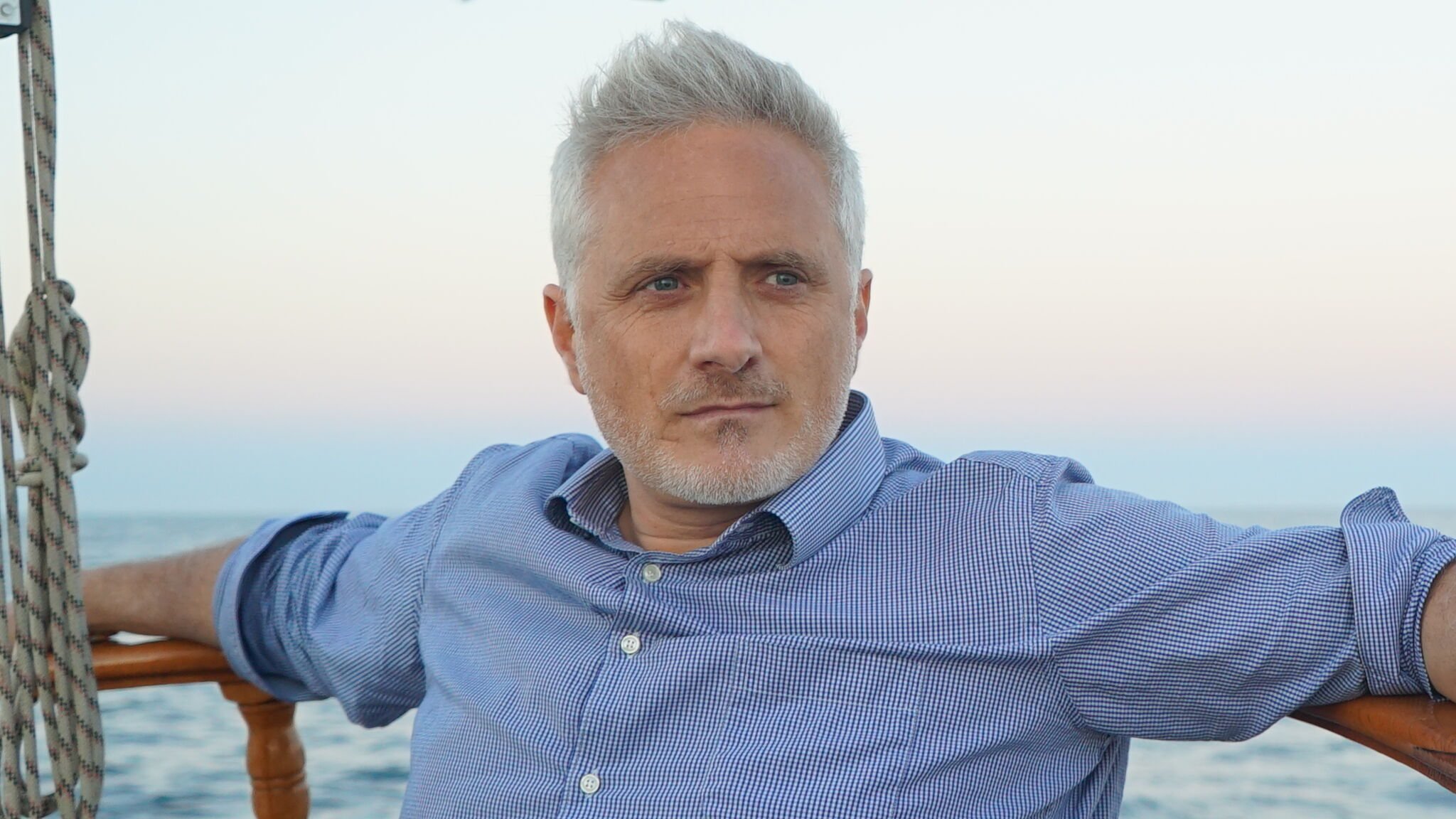
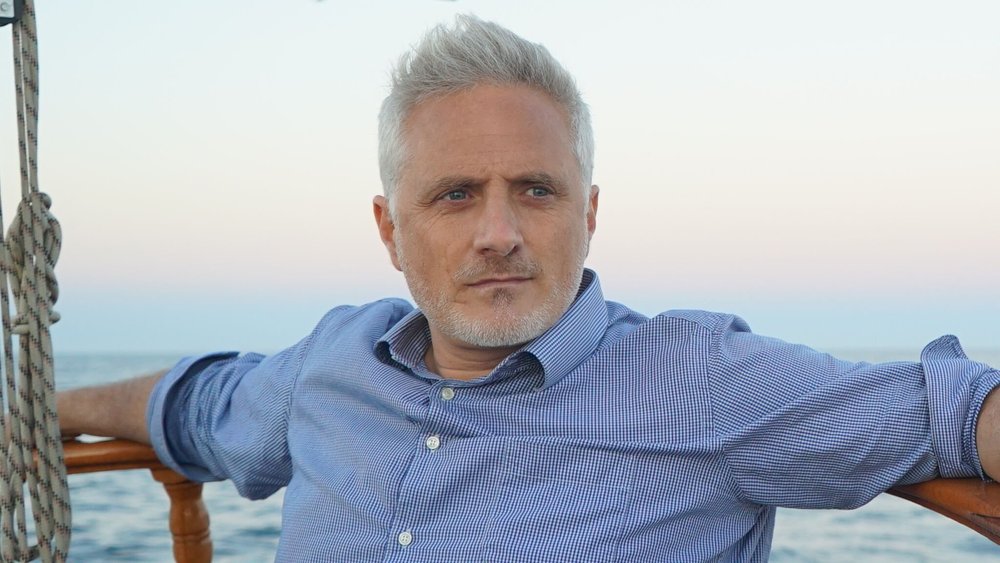
Writer · Director · Producer
Malik Basso
Over twenty years directing film and television across cultures and continents, with years in post-production behind him.
Screenwriter, Los Hombres de Paco (Antena 3), with showrunner Álex Pina, later of Money Heist.
His short Careless won a BBC Talent Award. Co-director of Socrates on Trial. Documentaries include The Dinar Movement (Al Jazeera), A Muslim Traveller’s Guide to Granada (Amazon Prime) and Mosaic.
Master in Film & TV Production, Edinburgh Napier University. Founder and Director of Bresca Media, Barcelona. Works in English, Spanish, French and Arabic.
How we make it
Hybrid: live action and AI
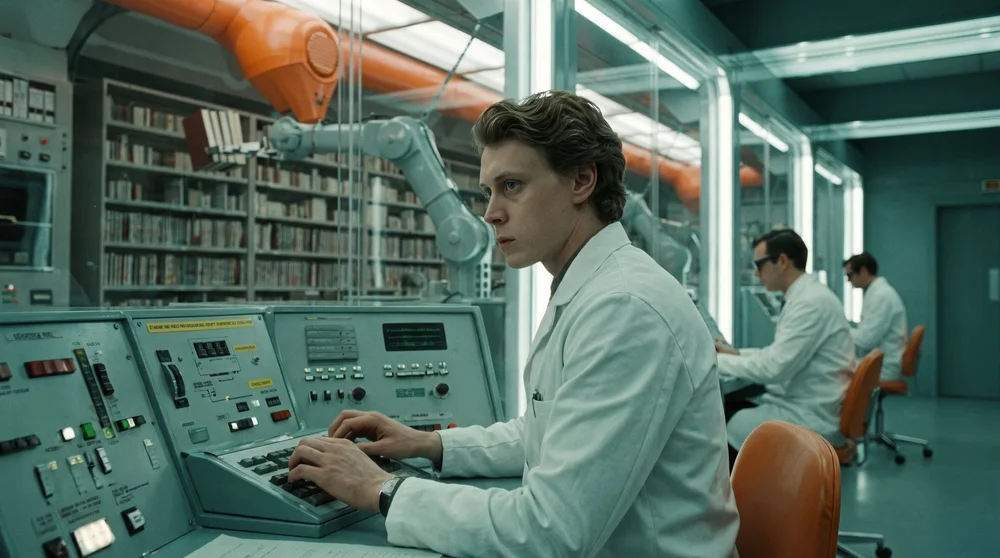
The State, built with AI
The Library, the city, the robots and the crowds are generated and composited around live actors, shot in one week on a small stage and in real modernist interiors in Spain. Bresca Media’s pipeline gives us a 1960s future at a scale this budget could never build.
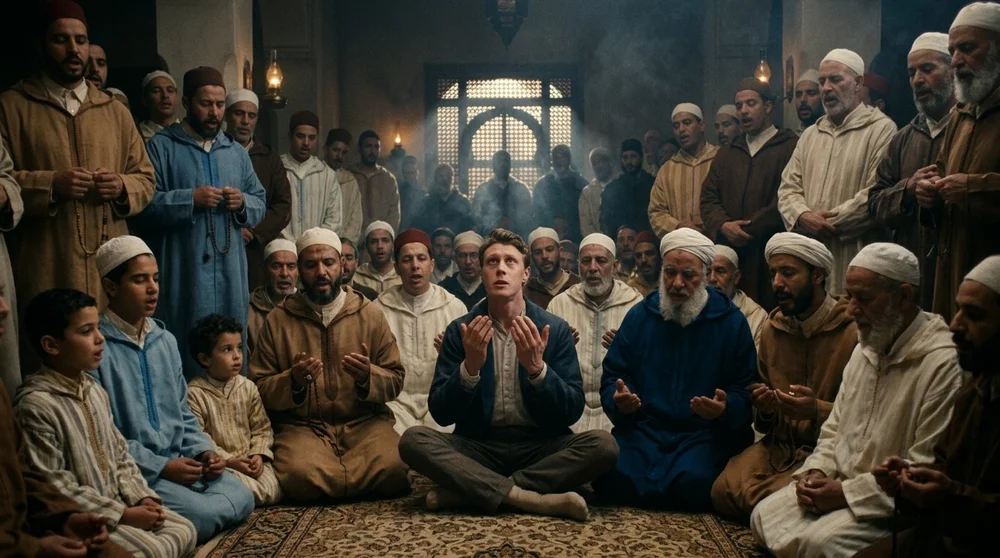
Morocco, filmed for real
Five weeks on location: an old walled city for Azwan and Nahb, a zawiyya for Falah, a settlement at the edge of a city for Wisal, and the desert. Real places, non-professional ensembles, practitioners on set for the Hadra and the Diwan.
One rule: no AI on faces in the sacred scenes. The prayer, the singing and the gatherings are filmed with the people who do them.
The concept images in this presentation were made by Bresca Media with AI. Book cover: first edition, 1972. Ian Dallas photograph: archive.
Budget summary
$2 million, all in
Schedule and finance
Development
6 months
Screenplay, rights, teaser, recce, attachments.
Pre-production
3 months
Casting, building the State, locations, crew.
Shoot
6 weeks
One in Spain, five in Morocco.
Post and AI
7 months
Edit, the State world, sound, music. Then festivals.
Target finance plan
Incentives depend on where the money is spent: Spain’s incentive for Spanish productions (30% of the first €1M, 25% after, with at least half the spend in Spain) or Morocco’s 30% cash rebate (minimum local spend of MAD 10M and 18 shooting days). The film rights are to be secured from the Dallas estate and Budgate Press, Cape Town, in development.
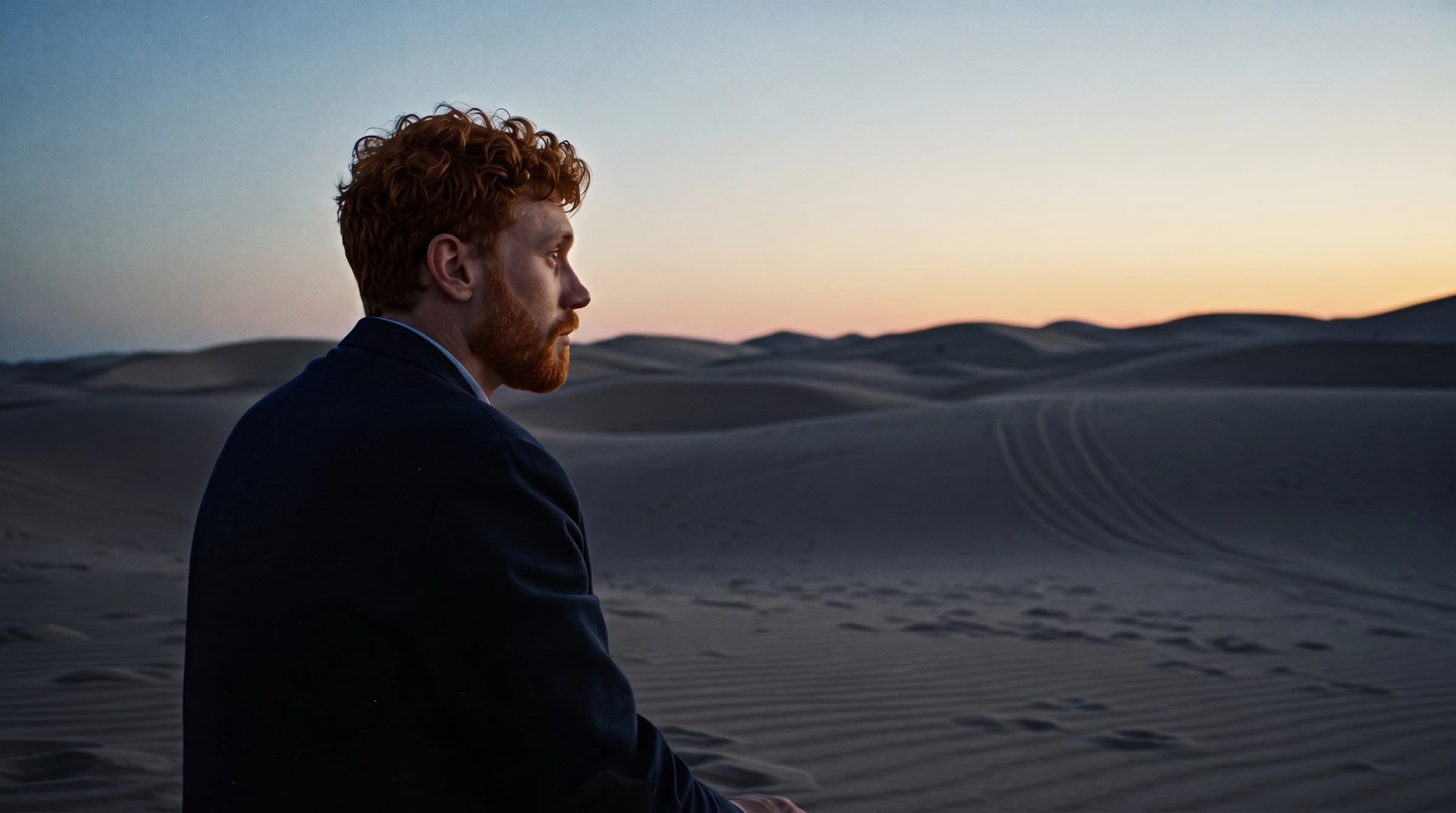
An invitation
To the students of Shaykh Abdalqadir
He gave this book to Malik at eighteen and told him to make it his own. Years later, in Cape Town, he reminded him of it. We are now gathering the people who will carry it with us: patrons for the first round, partners for the production, advisers on everything we must get right, and its first audience.
$120,000
Development. A finished screenplay with a script editor, the rights agreement with the estate, a proof-of-concept teaser of the State, a recce in Morocco, and the cast and partners attached.
“Islam began as something strange, and it will become strange again, as it began. So blessed are the strangers.”